How to respond when someone uses non-inclusive (or bigoted) language

by Sam Killermann · 12 comments

in Edugraphics

Intentions don’t matter, outcomes do.  However, I still think we need to do a much better job of being supportive of newcomers to the social justice “scene” who may be well-intended, but don’t quite know the ropes yet.  Following is my picture guide (sorry, no flowchart) of how to properly handle such situations, without scaring off a potential ally.
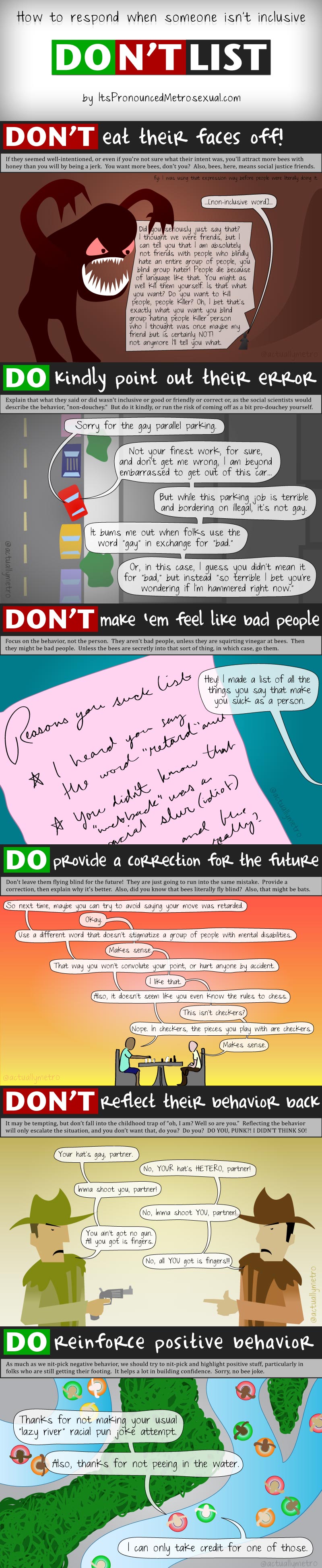
"How to Respond" Comic

Here’s the text (for folks who use screen readers):

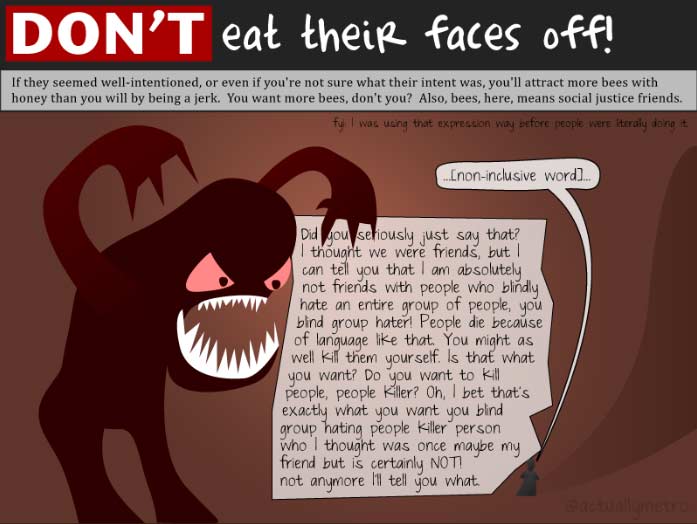
1. DON’T eat their faces off (FYI: I was using this expression way before people were literally doing this)

If they seemed well-intentioned, or even if you’re not sure what their intent was, you’ll attract more bees with honey than you will by being a jerk.  You want more bees, don’t you?  Also, bees, here, mean social justice friends.

2. DO kindly point out their error

Explain that what they said or did wasn’t inclusive or good or friendly or correct or, as the social scientists would describe the behavior, “non-douchey.”  But do it kindly, or run the risk of coming off as a bit pro-douchey yourself.

3. DON’T make them feel like bad people

Focus on the behavior, not the person.  They aren’t bad people, unless they are squirting vinegar at bees.  Then they might be bad people.  Unless bees are secretly into that sort of thing, in which case, go you.

4. DO provide a correction for the future

Don’t leave them flying blind for the future!  They are just going to run into the same mistake.  Provide a correction, then explain why it’s better.  Also, did you know that bees literally fly blind?  Also, that might be bats.

5. DON’T reflect their behavior back

It may be tempting, but don’t fall into the childhood trap of “oh, I am? Well so are you.” Reflecting the behavior will only escalate the situation, and you don’t want that, do you? Do you? DO YOU, PUNK?! I DIDN’T THINK SO!

(big thanks to Jesse in the comments for this one!)

6. DO reinforce positive behavior

As much as we nit-pick negative behavior, we should try to nit-pick and highlight positive stuff, particularly in folks who are still getting their footing.  It helps a lot in building confidence.  Sorry, no bee joke.

Have some additional DOs and DON’Ts?

I’d love to hear them.  And if I’m feeling particularly creative I might even comic-ize them and update the list above.  Share them in the comments, or drop us a line on facebook or twitter.
Written by Sam Killermann

Sam is a writer and performer who uses those skills as an ally to advance progress in the realms of LGBT equality and social justice. He tours the country speaking to college students about stereotypes, prejudice, and oppression, and writes for this site when he's at home in Austin, TX.

  • email
  • Jesse Russell

    DON’T relfect their behaviour to prove your point.
    EXAMPLE: “That was gay”, “Yeah, well your hat is is so hetero.” “Hey, what was that for?” “You started it.”
    Be mature and don’t play the “Well if you do it, I’m going to do it to” game. Sure, you can say things like “How would you like it if instead of ‘gay’ people used ‘straight’ or ‘breeder’ instead of ‘faggot’.” But when its like the example above, its just plain sad.

    Good job Mr. Killermann! (Or may I call you Sam?)

    • http://samuelkillermann.com/ Samuel Killermann

      Ooo, that’s a great one, Jesse! I’ll get to working on adding it to the comic, if you don’t mind.

      And you may certainly call me Sam, or any variation thereof :)

      • Jesse Russell

        Thank you Sam :)

    • http://samuelkillermann.com/ Samuel Killermann

      Done! Thanks, Jesse!

  • karen

    I think this is brilliant. You are my go-to-person when someone writes that stuff anyway. Thanks for another wee bit of positive social-justice enhancing arsenal.

    • http://samuelkillermann.com/ Samuel Killermann

      Thanks, Karen! I’m happy to hear that — it’s my big goal for the site :)

  • Pingback: Build Your Own World

  • 2cents

    This is good but my problem with these ideas is that a lot of people do the complete opposite of this list and chllenge why we *should* be the ones to have to inform when we’re not the ones makign the error.
    I’m not sure if I’m makign sense, all i can do is explain it in context. I’ve had to inform a few people when they’ve been offensive or said something that’s not appropriate but I’ve found- and online people here are more guilty because offline face-to-face people are generally more open to either ignoring or politely challenging- that it’s soemtimes not taken much to then upset and frustrate the person I’m explaining to because others are deliberately baiting them, beign rude or defensive.
    In the cases that I’ve seen this happening online, it was genuine ignorance on the part of the offenders the poster was a mid-teen or/and naive, and they’ve been dogpilled. Told naivity isn’t an excuse, that they are privilleged and they need to explore why not ask for links or expect explanations-in short that they are a terrible person and should go pay penance for it while finding out just what they’ve done.
    So while this approach may work for the majority in actuality, I believe this list won’t hold much merit online. It should, I definitely agree with it, but I’ve seen way too much dogpilling, trolling and refusing to explain to believe that many-certainly in the many communities I frequent which aren’t revolving around exploring and understandin this sort of thing- would actually agree with you. In fact, they’d probably say you’re wrong to write this list, stating that the onus isn’t on them but on the offender.
    This list works in the context of this and other website like it but from experience people either a) outside of the net ignore it as much s they challenge and b) online, if it’s ot this kind of webpage or forum and is something more personal-either fan based, artisty or even some comms (one of the afore mentioned dogpillings appeared on a feminist community), it’s very unlikely people will agree with you-let alone do.
    It’s a shame because i agree and have the same philosophy but i just know from experience it won’t be all that successful.

  • Pingback: 50+ concrete things you can do today to work toward social justice

  • sarah

    I think you’re showing your privilege off a little bit here. If you are being victimised your duty is to first and foremost protect yourself and not to educate the person in the wrong. Getting angry and chewing their face off is natural defense mechanism and I know I would definitely have succumbed a long time ago without it. Sure the person vicitisming you won’t learn as much but you can’t help anyone if you’re 6 feet under. You yourself, encourage anger in different post but I think you may misunderstand how anger works in a situation like this.

  • Pingback: How to Respond to Bigoted Language [COMIC] | Gamers Against Bigotry

  • Delila

    although i find these tips very necessary and hope people integrate them, i wonder if some people can truly learn how to separate themselves from their anger. people get very emotionally charged when offended, especially if they have deep rooted triggers. i’ve even seen good friends use social justice as a platform to release their anger, and they don’t seem to care about whether the person who made the offense learns anything. so i think you make good points here. honey over vinegar.
    i’m definitely still learning how to be a good ally, too, this is what i’ve noticed of SOME of my ‘social justice friends’ who call me out, or others.