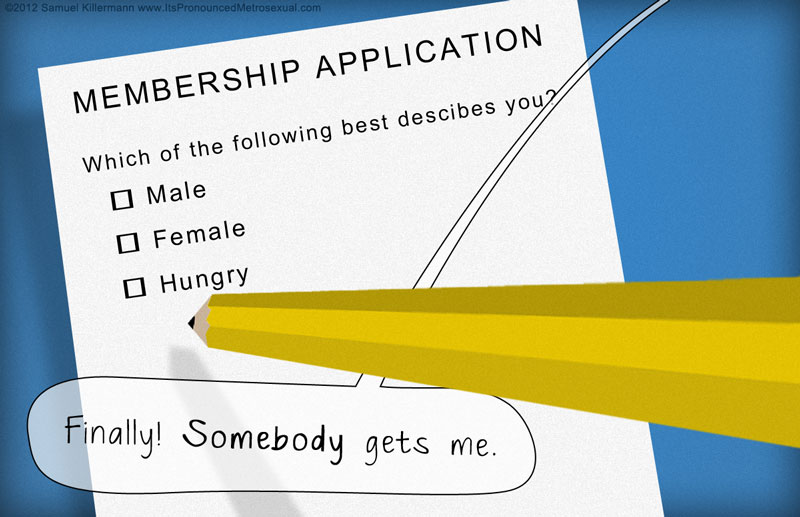
How can I make the gender question on an application form more inclusive?

by Sam Killermann · 23 comments

in Gender,Q & A

"Somebody Gets Me" Comic

This is the first installment of Q & A, where I respond to reader’s questions in a public article.  If you have a question, ask away.  The question is above, and my answer is below.

A lot of people are unsure of how to make an inclusive gender or sex question on a form, and default to “are you male or female?”  Let’s not do that.  Read on for some best practices and suggestions to make your forms more gender inclusive.

The first question I would ask in response to this dilemma is “what relevance does gender have to your membership application process?” Oftentimes, I’ve found that the reason people ask for gender is simply because they always have.  Is gender truly a relevant and necessary factor in making your selections (or whatever you’re doing with your applications?).  In a lot of cases it’s irrelevant.  If it’s irrelevant, don’t ask.  Problem solved.

If you’re asking because you want to know what gender pronouns to use to describe a person, simply ask that (“What are you preferred gender pronouns?” providing options and a fill-in-the-blank).

But let’s assume you have thought through that first question and want to proceed with a gender question on your application.  Below are are a few sample options/food-for-thoughts.

Sample Options/Food-for-Thoughts

Super simple solution, but one that is not easily sortable (in a spreadsheet):

1. I identify my gender as…
 __________ (fill in the blank)

If you don’t NEED gender, but would prefer to have it, here is one way you could do it:

2. I identify my gender as…
[] Man
[] Woman
[] Trans*
[] __________ (fill in the blank)
[] Prefer not to disclose

If you absolutely need to know gender, my next easy suggestion would be to simply remove the “not disclose” option:

3. I identify my gender as…
[] Man
[] Woman
[] Trans*
[] __________ (fill in the blank)

If you’d rather not have a fill in the blank because it will complicate things (e.g., make it harder to sort a spreadsheet), but you want to be incredibly inclusive and specific, here’s another suggestion:

4. I identify my gender as…
[] Man
[] Woman
[] Transgender
[] Transsexual
[] Genderqueer
[] Genderfuck
[] Non-gendered
[] Agender
[] Genderless
[] Non-binary
[] Trans Man
[] Trans Woman
[] Third Gender
[] Two-Spirit
[] Bi-Gender
[] Genderfluid
[] Transvestite

And if you’d rather have fewer options, even at the sake of inclusivity/specificity:

5. I identify my gender as…
[] Man
[] Woman
[] Trans*

And FINALLY, if you need to know sex rather than gender (the only examples that pop into my mind for a reason why are medical), here’s a way you can do it and still be inclusive:

6. I identify my sex as…
[] Female
[] Male
[] Intersex
[] MtF Female
[] FtM Male


A few additional thoughts

One of the things you’ll notice as a common thread throughout all of the questions is the prompt, “I identify my…”  I recommend this because it begins the action as a form of empowerment, instead of other options I’ve seen that often take the power to decide away from the individual answering the question.

Also, consider how you are going to be using the data you’re collecting before you decide how to collect it.  If you’re planning on matching people up based on gender (e.g., partners for activities, team relationships), you might ask for the applicants’ to report their gender but also ask them which gender they would feel most comfortable working with.  Then you can use their responses to place them in self-described comfortable partnerships, or choose to challenge them if you would rather see them working outside of their comfort zone.

I’m not a big fan of exhaustive lists when trying to describe identities (see #4), because they are rarely exhaustive.  And if you miss one or two, but include 15 others, those one or two get the sense of super-marginalization.  (did I miss any in #4 that you know of?)

Finally, this is not an exhaustive list of options, nor is it necessarily all right.  Share additional options, or revisions to the ones above, in the comments below!

 

Written by Sam Killermann

Sam is a writer and performer who uses those skills as an ally to advance progress in the realms of LGBT equality and social justice. He tours the country speaking to college students about stereotypes, prejudice, and oppression, and writes for this site when he's at home in Austin, TX.

  • email
  • Pingback: List of 5+ ways to make a transgender-inclusive world.

  • Sevan

    I dig it! Good list. Especially the bit about “if you don’t need this data, don’t collect it.” Cuz…srsly!! 

    • http://samuelkillermann.com/ Samuel Killermann

      Thanks, Sevan — that’s absolutely my favorite part as well :)

  • Eli

    I actually strongly dislike forms that have “man”, “woman”, and “trans(*)” as separate options. Since it’s often only possible to select one option, this suggests that all three categories are mutually exclusive and supports the implication that “(wo)man” really means “cis (wo)man.” As a trans man (to whom both of those words are equally important in describing my gender), I hesitate over which box to check.

    Presenting a list like #4 compounds the problem. There are at least four terms in the list that would apply to, e.g., a trans man with a binary identity. Listing “transgender” and “transsexual” as options, but not “cisgender” and “cissexual”, is othering rather than inclusive.
    #6 is also not a good option for medical forms, for the simple reason that none of the options actually tell you anything about body parts. Two people who have pursued different paths in terms of hormones and surgery may both check the “FtM Male” box but require very different medical care. Likewise, “Intersex” as a checkbox is of limited use because it’s a term that encompasses so many different types of anatomy. More useful would be giving people a chance to indicate their preferred pronouns (so providers know how to talk about them) and then indicate specific services or health topics that are applicable to them based on the parts that they have (e.g., pelvic exams, mammograms, menstruation, the HPV vaccine, contraception or fertility services).

    • http://samuelkillermann.com/ Samuel Killermann

      Eli, thank you for the comment and the criticism.  Seriously.  I love your enthusiasm.  Now help me make this better.  I’ve read and re-read your comment, but it would be helpful for me to have some concrete suggestions/revisions to employ on this article.  

      What can I do to make it better?

      • Eli

        Well,
        I tried to provide some concrete suggestions about #6. In terms of #s
        2, 3, and 5, which are all variants on “men”/”women”/”trans*”
        … the thing is, as I said, that these three options are not
        mutually exclusive and should not all be included as response options
        when data-gatherers are expecting people to select only one.

        The
        reason that they’re not mutually exclusive is because they talk about
        different things. “Man” and “woman” (and “genderqueer”,
        “bigender”, “two-spirit”, etc.) describe gender identity.
        “Trans*” (and “cis”) describe the legitimacy that’s granted
        to someone’s gender identity, in relation to their body and to
        normative standards of gender expression. These are fundamentally
        different concepts.

        So
        I’d suggest that asking people to identify their gender should be a
        separate question from asking whether they are cis or trans. Which
        means that, yes, when people are designing forms they need to put
        some extra thought into which of those questions is really important
        to them. And whenever “trans*” is listed as a checkbox, “cis”
        should be listed too. This:

        -
        does not other trans people by framing cis identity as a normal,
        unmarked default.

        -
        avoids the implication that all trans people identify outside of the
        man/woman binary, or that a trans person’s (wo)man identity is
        fundamentally different from a cis person’s (wo)man identity.

        -
        allows for more precise and less socially loaded data collection.

        I
        would never attempt to use #4, or a variant thereof, in a situation
        where I hoped to tabulate results in a meaningful way. Invariably it
        would lead to one of the following:

        a)
        If people are allowed to select multiple options, some people will
        select several boxes, making the data very difficult to interpret.

        b)
        If people areonly allowed to select one box, people who identify in
        ways that are covered by multiple boxes (e.g., “trans*”, “man”,
        and “trans man”) will make a variety of choices about which one
        box to select, so that people who should be grouped together end up
        split in the final analysis, making the data very difficult to
        interpret.

        c)
        If the list is not comprehensive enough, some people will not be able
        to select an appropriate option – this presents obvious problems.

        d)
        If the list is comprehensive, it will include an unwieldy and
        unmanageable list of options, along the lines of Genderform:
        http://www.yaygender.net/pages/gender.pl

        Make
        sense?

        (as
        a side note, I really like Gbroder’s suggestion of saying “another
        identity” rather than “other”!)

        • Eli

          Whoops — somehow my formatting got messed up. I hope you can piece that together okay.

  • Twish

    My favourites are 1 and 3, although today If I had to put a form I’d opt for 3. With 1, the applicant might not really realise you’re actively trying to be inclusive, and out of fear of public humiliation would write ‘male’ or ‘female’ even if they feel otherwise, something which doesn’t align with physical gender (e.g. someone who identifies as third gender but is apparently male perhaps)

    3 shows that the applicant is really truly free to express how they feel, as there is an ‘out-of-the-norm’ option (as an option, not an identity) which indicated that whoever is collecting the data is ok with trans* people and makes the applicant feel more comfortable. We run into the problems Eli mentioned though. 

    In response to Eli, would replacing Male and Female with CisMale and CisFemale be better, you think? If you put an asterisk and explain the terms at the bottom, the form itself becomes an educational document as people who are unaware of the idea of Cisgender can learn.
    Also re. #4, sometimes I feel that there is such a thing as being too inclusive? As in, it’s a bit of a ‘spin off’ of positive discrimination, but sometimes when someone goes too far in being socially inclusive (e.g. for example with me being gay) sometimes I feel uncomfortable, because there are instances where sexuality is not an issue and by trying to be super inclusive you’ve turned it into one. Also on such an application, the applicant often has no idea who he’s applying to. It’s kind of scary when someone wants to know so much so fast about you, especially if you’re still getting used to being public about your identity.Although the most elegant solution, is not collecting the data at all :)

    • Twish

      The first paragraph – ignore between ‘something’ and ‘physical gender’. Not even sure myself what I was trying to say with that.

  • switcher

    In response to the idea that one should not collect data they don’t need: I agree. However, often times the data is collected not because the company/person/organization NEEDS the data but rather because they want to use it for statistics. Its helpful to know how many men/women/trans* people you have, its helpful to know where your organization stands in terms of how many lesbian/gay/bi/otherwise people it has as well. Not because the company needs to judge the group but because its easier to figure out just what the people in your organization will need without wasting resources on things they will not need. For example if you have ONLY lesbian/straight identifying cisgender women it is a better use of resources and money to offer better female oriented services and not use money/resources on male oriented ones. My point, simply being that when asking for gender there is never a reason outside of medical that a person should not be given the option to of “prefer not to respond”. I can’t think of a situation where someone NEEDS the info, just wants it to help makes things better for the org. 

    As for the inclusive list. I think its great that you wrote this post but I as I read through your ideas, I couldn’t help thinking no matter what list I encountered I would still be uncomfortable. I mean an organizations policies might be inclusive but has that trickled down to the person reading my application/survey? Its still legal in some situations to discriminate based on gender identity so even if they say they won’t, they will still see it and will they take it into account and say my qualifications don’t match? This is a great idea, one that in a perfect world would be great to have. But in a world where I can still lose a job/not get hired for reasons unrelated to my job qualifications I will always choose “prefer not to answer”. Besides, even if I went with my physical sex and checked of “female” would that really benefit me? Too much discrimination in this world makes that question way too loaded way to often. (not your fault sam BTW, the idea of an inclusive list is cool). 

    Also, if you’re living in a perfect world. And you’re going to have an inclusive list. I would say adapting number 2 is probably your best bet. In that you could leave off the option of other but put a parenthetical list *(list all trans identities plus other with a line to define) and give the person the option to check trans* and leave it or check trans* and circle one. 

    • http://seth-vs-world.tumblr.com/ Seth

      An anonymous survey would be better, though– wouldn’t it? That way people know their rights aren’t going to be violated. It also makes them less likely to lie and would therefore be more accurate.

      • switcher

        yes, but in an electronic world is anything ever truly anonymous?

  • http://runningonempathy.blogspot.com Ophelia

    My suggestion is to handle gender the way many forms handle ethnicity/race: include the option to “check all that apply.” It irritates me to no end to get a form that says “male / female / transgender” because it means I can’t choose “female” and “transgender” at the same time, even though the authors are trying to be inclusive of trans people. Here’s how I’d word it:

    “I identify my gender as …. [check all that apply]
    [ ] Male
    [ ] Female
    [ ] Trans*
    [ ] Cis
    [ ] Other (please specify) ____________ ”

    You can clarify what “cis” and “trans*” mean if you’d like, but even then I doubt you’d get too many people checking “cis” outside of social justice circles. However, this is fairly simple (aka not 15 options), encompasses a wide variety of people, and isn’t cisnormative. 

  • Gbroder

    Thanks for writing about this issue! I agree with you – if you don’t need the data, don’t collect it. Another thing my organization has done is change the fill-in-the-blank option (which often gets presented as Other: _____). Who wants to be thought of as “other”?! So we use “Another identity:______). We also use the “check all that apply” that Ophelia mentioned below.

  • http://seth-vs-world.tumblr.com/ Seth

    It doesn’t work to make the third option “trans*” because that suggests that either all trans* people don’t consider themselves binary, or that they don’t count as real males/females. When I encounter a form like that I don’t consider it inclusive or accepting at all. Transgender is NOT AT ALL a gender identity to many if not most trans* people.

    What I’d do is this:What is your gender identity?[  ] female[  ] male[  ] something else/nothing (please specify below if you wish:)______________________[  ] prefer not to sayAnother question to ask yourself is if you really need to know the person’s gender, or if you just need to know what pronouns to call them. If so, that would be a MUCH better question:Please specify your preferred pronouns:[  ] he/his/him[  ] she/her/her[  ] other (please specify) ______/_______/______[  ] none (use name only)

    Even if you DO need to know the person’s gender, it’s still a very good idea to ask about their pronouns, because if someone is going to be referred to at all, you’ll need to know what they want to be called. There isn’t a standard gender-neutral pronoun everyone agrees with yet, and even if there was you still need to ask just in case someone prefers something else.

    • switcher

      I agree with you about the pronouns thing. If its an application or form for something where you are going to interact with the person afterwards you should find out their pronouns. I always get pushback that it would confuse or offend people that have never had to explain their gender expression or identity, but too bad for them I guess they can just check of the “normal” (as they may see it) pronouns. 

      I think though that its good to have woman, man and trans on the list while providing a “check all that apply” option and a specify option. While there are trans folks who fully identify as male or female there are also trans folks who may be somewhere in the middle or somewhere different. I would also say a trans person who fully identifies as male or female should be allowed, able and feel comfortable checking off their true gender (male/female) instead of trans if they so chose. 

      • http://seth-vs-world.tumblr.com/ Seth

        About the thing about having a trans* option– I think it’s much better to have a ‘fill in the blank’ sort of thing as a third option, as it lets people identify as they wish. That way, if a nonbinary person is uncomfortable with the trans* label or think that it doesn’t accurately describe their gender, they can write down something more accurate.

        Also, having trans* as an option next to female and male would probably give cis people the idea that it’s okay to consider all trans* people to be in-between genders or something else like that.

        That’s why I put down “something else/nothing (please specify below if you wish:)” It lets trans* people know that you respect them.

        • switcher

          You’re right that having trans* as a third option would not help to show people that a person who is trans* can identify fully as male or female. An uninformed cis person would not be more educated with Trans* as a third option, I totally agree. 

          But, I don’t think that we should take it off the list just because of how someone else will see it. Somebody might not be comfortable writing in their identity or it might be too complicated for the form, and also write ins are easily sortable in an spreadsheet format.  So, I suppose in some situations it might work to not have trans* as an option but rather to provide a write in section, I just really think we need to allow people the option to choose trans* if that is how they identify. Trans* plus woman or man, or just trans* or just woman or just man or just woman and man or whatever. 

          “something else/nothing” makes me feel like an alien. Idk. Like “are you man, woman, or extra terrestrial” Just my opinion though, others may feel otherwise. 

          • daemon

            why not use “non-binary” or something similar? this allows people to choose a non-binary gender without having to write something specific in, but also does not alienate binary transgender people.

  • rowdy

    Dopp Juice has some fantastic thoughts on this:

    1) Finite lists always exclude someone
    2) Use Facebook-esque “it’s complicated” as the non-binary option
    3) Like OKCupid does for Religion, let people select “and serious about it” … “and laughing about it” as a modifier on their selected gender
    4) Just have an auto-completing free text tagging field, people can use other commonly used words, or invent their own

    http://www.sarahdopp.com/blog/2010/designing-a-better-drop-down-menu-for-gender/

  • Pingback: Lista de 5+ formas de fazer um mundo mais inclusivo para trans* « Traduções voluntárias

  • Pingback: 50+ concrete things you can do today to work toward social justice

  • Snydo

    Thanks so much for your awesome work! I am a medical student and I would like to some day have a totally inclusive practice. A lot of what we learn is very rooted in the gender binary including the basic medical intake interview. Naturally I have been wondering how to make this kind of form more inclusive while getting any medically relevant info and hopefully opening a conversation so that Trans patients know that they are welcome in my practice.
    Being Cis, I really appreciate the info and resources that you have here that are helping me understand some of the privileges and assumptions that I can make (I’m bi and rejected the gender binary ages ago, but I know that this does not mean that I intrinsically understand the experience of others or don’t benefit from Cis privilege. I’m sure I make assumptions sometime or put my foot in my mouth and I want to be part of the solution not the problem. :P )