30+ Examples of Christian Privilege

by Sam Killermann · 169 comments

in Privilege Lists,Social Justice

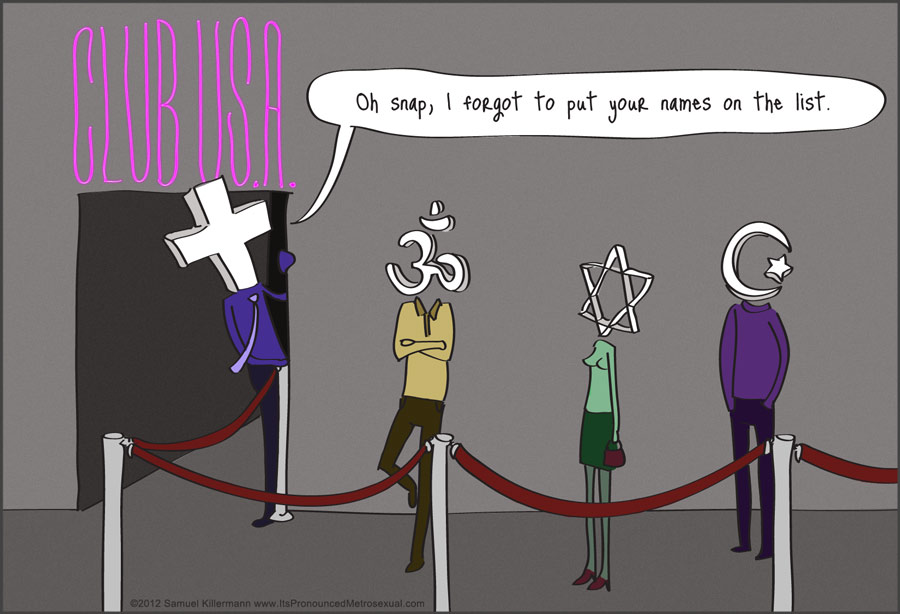
"Not on the List" Comic

Get on my mailing list!
Following is a list of privileges granted to people in the U.S. (and many western nations) for being Christian.  If you identify as Christian, there’s a good chance you’ve never thought about these things.  In response to the ever-increasing “War on Christianity” headlines, I thought it prudent to create this list.  Try and be more cognizant of these items and you’ll start to realize how much work we have to do to make the United States a place that is truly safe and accessible for folks of all belief systems.

Please comment below if you have any additions or revisions to make!

  1. You can expect to have time off work to celebrate religious holidays.
  2. Music and television programs pertaining to your religion’s holidays are readily accessible.
  3. It is easy to find stores that carry items that enable you to practice your faith and celebrate religious holidays.
  4. You aren’t pressured to celebrate holidays from another faith that may conflict with your religious values.
  5. Holidays celebrating your faith are so widely supported you can often forget they are limited to your faith (e.g. wish someone a “Merry Christmas” or “Happy Easter” without considering their faith).
  6. You can worship freely, without fear of violence or threats.
  7. A bumper sticker supporting your religion won’t likely lead to your car being vandalized.
  8. You can practice your religious customs without being questioned, mocked, or inhibited.
  9. If you are being tried in court, you can assume that the jury of “your peers” will share your faith and not hold that against you in weighing decisions.
  10. When swearing an oath, you will place your hand on a religious scripture pertaining to your faith.
  11. Positive references to your faith are seen dozens of times a day by everyone, regardless of their faith.
  12. Politicians responsible for your governance are probably members of your faith.
  13. Politicians can make decisions citing your faith without being labeled as heretics or extremists.
  14. It is easy for you to find your faith accurately depicted in television, movies, books, and other media.
  15. You can reasonably assume that anyone you encounter will have a decent understanding of your beliefs.
  16. You will not be penalized (socially or otherwise) for not knowing other people’s religious customs.
  17. Your faith is accepted/supported at your workplace.
  18. You can go into any career you want without it being associated with or explained by your faith.
  19. You can travel to any part of the country and know your religion will be accepted, safe, and you will have access to religious spaces to practice your faith.
  20. Your faith can be an aspect of your identity without being a defining aspect (e.g., people won’t think of you as their “Christian” friend)
  21. You can be polite, gentle, or peaceful, and not be considered an “exception” to those practicing your faith.
  22. Fundraising to support congregations of your faith will not be investigated as potentially threatening or terrorist behavior.
  23. Construction of spaces of worship will not likely be halted due to your faith.
    Get on my mailing list!
  24. You are never asked to speak on behalf of all the members of your faith.
  25. You can go anywhere and assume you will be surrounded by members of your faith.
  26. Without special effort, your children will have a multitude of teachers who share your faith.
  27. Without special effort, your children will have a multitude of friends who share your faith.
  28. It is easily accessible for you or your children to be educated from kindergarten through post-grad at institutions of your faith.
  29. Disclosing your faith to an adoption agency will not likely prevent you from being able to adopt children.
  30. In the event of a divorce, the judge won’t immediately grant custody of your children to your ex because of your faith.
  31. Your faith is taught or offered as a course at most public institutions.
  32. You can complain about your religion being under attack without it being perceived as an attack on another religion.
  33. You can dismiss the idea that identifying with your faith bears certain privileges.
  34. Share more in the comments below!

Written by Sam Killermann

Sam is a writer and performer who uses those skills as an ally to advance progress in the realms of LGBT equality and social justice. He tours the country speaking to college students about stereotypes, prejudice, and oppression, and writes for this site when he's at home in Austin, TX.

  • email
  • http://www.facebook.com/people/Heather-Boster/537236235 Heather Boster

    How about this? 

    “In the event of a divorce, the judge won’t immediately grant custody of your children to your ex because of your faith.”

    To anyone who doesn’t believe this happens, google pagan mom loses custody. 

    • http://samuelkillermann.com/ Samuel Killermann

      Added.  Thanks for contributing, Heather!

    • Rebecca of Ask An Atheist

      or “Atheist dad loses custody” or “Agnostic dad loses custody”

  • Ben Stallings

    I’m confused about the wording of #9… why will your peers hold your faith against you if they share it?

    • http://samuelkillermann.com/ Samuel Killermann

      Reworded.  Thanks, Ben.  I forgot the ever-important and meaning-altering word “not.”  

  • Orthodox Xian

    While, having been born in a predominantly Muslim country, I value what the U.S. has afforded me and my family…in that we are able to practice our Christian religion openly and without fear of persecution. However, the list given by this article is a bit ridiculous. I will respond to the first 10. 

    1. You can expect to have time off work to celebrate religious holidays. >> Not really. I’m Orthodox Christian. And number two, my law school’s graduation is on a Sunday MORNING (as have been many other important events)…because my law school (which is not predominantly jewish) is catering to those who observe a Saturday sabbath. Christians are expected to be more flexible in skipping church. Thanks. 2. Music and television programs pertaining to your religion’s holidays are readily accessible. >> My religious holidays have been commercialized, and that is somehow a good thing for me? Nope. 3. It is easy to find stores that carry items that enable you to practice your faith and celebrate religious holidays. >>What are you talking about? What items? Plastic easter eggs? A Christmas tree? That has nothing to do with “religion”. Plus most food in stores is Kosher anyway where I live (NYC). 4. You aren’t pressured to celebrate holidays from another faith that may conflict with your religious values. >>No one was pressured to celebrate Christmas as the birth of Jesus Christ. They were pressured to get gifts and new toys at the same time their friends were. 5. Holidays celebrating your faith are so widely supported you can often forget they are limited to your faith. >> Nope. Trust me, when I am celebrating Easter, there is no way to forget that Easter, the RESURRECTION of Jesus Christ, is central to Christianity only. 6. You can worship freely, without fear of violence or threats. >> Really? 7. A bumper sticker supporting your religion won’t likely lead to your car being vandalized. >>Really? I’ve seen Christian bumper stickers being scratched off. 8. You can practice your religious customs without being questioned, mocked, or inhibited. >> Really? I had a professor in law school ask who was Christian, only for him to mock those of us who raised their hands. Fake Christianity is not inhibited. Real faith is looked down upon. 9. If you are being tried in court, you can assume that the jury of “your peers” will share your faith and hold that against you.>> Huh? What does this even mean? 10. When swearing an oath, you will place your hand on a religious scripture pertaining to your faith. >> How is this Christian privilege? Perhaps. I mean, if you think in terms of feeling alienated and having to swear on a Bible as a reminder that you are different. Ok. I will give you this one.

    • http://samuelkillermann.com/ Samuel Killermann

      I’ll play along.  1. You don’t get time off for Christmas?  2. The fact that you can complain about how popular your faith’s holidays are is a demonstration of an incredible amount of privilege.  3. Bibles, crucifixes, whatever else they sell at all those Christian stores (here’s a common one in Austin: http://www.familychristian.com/).  And yes, little plastic eggs.  4. People are pressured to celebrate Christian holidays thousands of times a day during holiday seasons.  If you had played the Halloween card here I would have been more impressed.  5. You’ve never wished a Happy Easter to someone not knowing their faith?  6. Relative to other faiths, a few in particular, yes.  Really.  In fact, more people are met with violence and threats at the hands and mouths of Christians than otherwise.  7. It’s easier to replace a sticker than a windshield or tire (not that sticker scratching is okay – it’s not).  8. That professor is an ass.  And again, you are simply reinforcing the idea of privilege by bifurcating your faith and saying that “fake” practitioners of your faith have privileges that you don’t.  An uneducated white person doesn’t have the same education as a law-school graduated white person, but that doesn’t erase the idea that easy access to higher education is a white privilege.  9. Typo.  Fixed it.  Now feel free to present a flimsy counterpoint.  10. Thanks :)  1 in 10′s not bad.

      Thanks for adding a very important addition to the list: you can dismiss the idea that identifying with your faith bears certain privileges.  In a US privilege head-to-head, Jews would definitely top Muslims, but I can’t imagine a Jew dismissing the privileges of access to Kosher food, the “commercialization” of Hanukkah, and the availability of synagogues.

      • http://www.facebook.com/profile.php?id=692587963 Liz Jones

        Please don’t overlook the fact that the poster is a practitioner of Orthodox Christianity, whose religious holidays fall on different days than Catholic and Protestant holidays, so it may NOT be a given for  her to get religious holidays off. 

      • http://omo.peacockfairy.com/ Ruadhán J McElroy

        Orthodox Christianity (if I recall correctly) uses the Julian calendar.  Mainstream Catholic and Protestant Christianity, on the other hand, uses the Gregorian calendar.  So no, Orthodox Christians, in the US, are not automatically given their religious holidays off from work.

        • Lex

          This list pertains more to protestant Christians — and that distinction is extremely important.

          Other Christian denominations are considered outsiders by a significant (and vocal) chunk of protestants. I have come across many Southern Baptists who would tell you that Orthodox Christians aren’t really Christian because they believe wrong. I would say the order of preference goes: Protestant > Catholic > Orthodox > Jewish > Muslim > Hindu > Pagan/Agnostic/Atheist. I am not sure where Buddhism, Sikh, Shinto, etc would fit in there. Where they draw the going to hell cutoff varies greatly among denominations, churches, and individuals.

    • http://omo.peacockfairy.com/ Ruadhán J McElroy

       With the exception of the Orthodox / Julian calendar holidays, everything you’ve pointed out and whined about are exceptions that sort of prove the rules, or are complete non-issues.

      2. Music and television programs pertaining to your religion’s holidays
      are readily accessible. >> My religious holidays have been
      commercialized, and that is somehow a good thing for me? Nope.

      Name me one Channukah pop-song that’s not by Adam Sandler.  Better yet:  Name me one song pertaining to ANY polytheistic religion (Hindu, Shinto, certain Buddhist sects, most pagan religions…)

      3. It is easy to find stores that carry items that enable you to
      practice your faith and celebrate religious holidays. >>What are
      you talking about? What items? Plastic easter eggs? A Christmas tree?
      That has nothing to do with “religion”. Plus most food in stores is
      Kosher anyway where I live (NYC).

      I was able to Google up several Christian book stores in Manhattan very easily.  I have easily found dozens of general grocery stores, including a Kroger in 28th Street, that are not Kosher-speciality.  Commercial “kosher” food is almost never overseen by a rabbi and is just a marketing term used to indicate that it complies with every other Jewish dietary law –most packaged food is kosher by default, and the fact that you see signage pointing this out all over NYC speaks more to the fact that NYC has a higher concentrated Jewish population than almost anywhere else in the States –just like Dearborn, Michigan has a higher concentration of Muslims than anywhere else in the States, so “Halal” is all over everything in metro-Detroit.

      4. You aren’t pressured to celebrate holidays from another faith that
      may conflict with your religious values. >>No one was pressured to
      celebrate Christmas as the birth of Jesus Christ. They were pressured
      to get gifts and new toys at the same time their friends were.

      Except for the fact that, as a non-Christian, I have been pressured to do so.  I have had people, point blank, tell me that I should be celebrating Christmas.

      5. Holidays celebrating your faith are so widely supported you can often
      forget they are limited to your faith. >> Nope. Trust me, when I
      am celebrating Easter, there is no way to forget that Easter, the
      RESURRECTION of Jesus Christ, is central to Christianity only.

      Except for the fact that the secularised trappings of Christmas and Easter are actively employed by a majority of Christians in Western society, which does, in fact, lead many to forget that those holidays are, in fact, limited to Christianity.  The closest holiday of polytheistic origin to Christmas is the Roman Saturnalia, which absolutely was not celebrated on 24 & 25 December.

      6. You can worship freely, without fear of violence or threats. >> Really?
      Yes, really.  The few Christians who may be actively threatened?  This is typically for something other than being Christian –and not to mention that, by sheer per-capita numbers, non-Christians are threatened in Western society for simply being non-Christian at practically hundreds of times greater the rate than Christians are threatened for practising Christianity.

      7. A bumper sticker supporting your religion won’t likely lead to your
      car being vandalized. >>Really? I’ve seen Christian bumper
      stickers being scratched off.

      Do you know what “likely” means?  Do you understand the principles of probability?  I can guarantee you, for every one Christian bumper sticker you’ve seen “scratched off”, I’ve seen at least ten times as many cars bearing Hindu, pagan, Buddhist, or even atheist stickers and emblems not only have their stickers “scratched off” and emblems broken, but sugar in the petrol tanks, cars egged, I’ve even seen in a parking lot a case where somebody literally took a shit on the hood of the car in the hot sun, the paint of the car keyed up on the door panels, and at the rear bumper, a “Coexist” sticker “scratched off” and the words “Jesus Saves” written in the dust on the back windscreen.  I can guarantee you, for every sticker you’ve seen “scratched off” (a vague description), I’ve seen between five and ten counts of genuine and clear vandalism to cars bearing non-Christian slogans.

      8. You can practice your religious customs without being questioned,
      mocked, or inhibited. >> Really? I had a professor in law school
      ask who was Christian, only for him to mock those of us who raised their
      hands. Fake Christianity is not inhibited. Real faith is looked down
      upon.

      And where is this professor now?  I’d find it hard to believe if this has continued without reprimand.

      9. If you are being tried in court, you can assume that the jury of
      “your peers” will share your faith and [not] hold that against you.>>
      Huh? What does this even mean?

      You really are sheltered, huh?  Clear typo aside, what that means is that there is no shortage of cases where all or predominantly Christian juries have immediately formed unfavourable opinions of a defendant because they were of a non-Christian religion.

      10. When swearing an oath, you will place your hand on a religious
      scripture pertaining to your faith. >> How is this Christian
      privilege? Perhaps. I mean, if you think in terms of feeling alienated
      and having to swear on a Bible as a reminder that you are different. Ok.
      I will give you this one.

      Are you serious?  How is that not Christian privilege?  The fact that you don’t even understand that there’s privilege there that has nothing to do with some vague concession of “alienation” proves that it is a privilege that you take for granted.  What does it mean for you, as a Christian, to have to swear on The Bible?  Now think about that long and hard.  Try not to hurt yourself in the thinking process.  What meaning can it possibly have to a Hindu to swear on a Christian text to tell the truth?  This is not their holy book, they might as well swear on the pages of Tom Sawyer, as it would probably mean about as much to them. 

      • Megan

        2. This comment isn’t meant to contest the fact that there’s not a lot of pop-songs for Channukah (or other non-Christian holidays)… but I just wanted to throw it out there that the Canadian band “Barenaked Ladies” has a winter/holiday album that has Christmas, Channukah, and winter season songs. Just in case someone is looking for that: http://en.wikipedia.org/wiki/Barenaked_for_the_Holidays

      • Randi

        I’m not a Christian (and never had to swear an oath in court) and reading this one was in fact the most jarring to me. Having not had to swear an oath in court before, it never dawned on me that I might be required to swear on the KJ bible. The fact that this person doesn’t think this is Christian privilege is INSANE. To me, this was suddenly the most offensive of the list. Also, what happened to division of church (pah! more likely christian privilege) and state. Shouldn’t I be swearing on the constitution or something?

        • http://twitter.com/ViveLeShelby Shelby

          I agree! I was surprised in elementary school when I found out that people swear on the bible in court. I assumed it would be the constitution, because that’s the most important secular document to our country. And I found out all of this right after the separation of church and state was explained to me, so it was even more confusing. I definitely agree that this is one of the most offensive examples of Christian privilege on the list, because it’s so obvious, like “In God we Trust” on money, and use of prayer and God language in other legal and government settings. It makes me feel like the Bill of Rights doesn’t actually matter as much as the opinions of the people in charge, because they’re free to make whatever rules they want as long as the majority supports them, often times at the expense of minorities (Or people who just aren’t loud mouths!).

      • http://www.facebook.com/jessica.neubauer Jessica Neubauer

        Good points all, and you write clearly and concisely. But please don’t feed the trolls

      • http://www.facebook.com/christa.landon Christa Landon

        OK, would YOU swear, “So help me Goddess?” How would it feel for YOU to be forced to swear on my Grimoire? This is an exercise in stepping OUT of your theological/cultural circle enough to imagine what it is like to be other than who you are. The Oppressed survive by learning how the Oppressors think, so we can “pass” if need be, or be prepared for the next attack. One mark of the Privileged is that they find it very difficult to think how someone from the other “side” feels.

    • http://www.facebook.com/nell.webbish Nell Webbish

      OX, you are making a very common mistake when discussing privilege … you are personalizing it instead of stepping back and seeing how privilege works on the macro level. I understand the struggle. As a white woman it took me a long time to fully understand how white privilege exists in the world. Grasping it once makes it easier to see how it works in other areas also.

      I strongly recommend that you read the blog post linked below. Though it is focused on male privilege, it is one of the most outstanding explanations of what privilege is and is not that I have ever found. http://whatever.scalzi.com/2012/05/15/straight-white-male-the-lowest-difficulty-setting-there-is/

      Finally, recognizing your own privilege is not tantamount to admitting culpability for things outside of your control. It is not an accusation that you have not worked in your life or struggled or that at times people were rude or hateful to you. It is simply a recognition of what it means to be a member of a group that is considered a cultural default.

      Denying it exists with trite and silly objections is not very admirable.

  • Guest

    reading this is like someone telling you that your car getting stolen is no big deal because you have three other cars. 

    • http://www.ericteske.com/ Eric Teske

      I don’t think that’s an accurate analogy. Reading this is like having someone point out the fact that you drive a safe luxurious car, being annoyed when people mention their unsafe cars, or feeling attacked when someone else also buys a luxurious car. 

    • http://samuelkillermann.com/ Samuel Killermann

      What Eric said, OR I can completely grant you that analogy, if you realize that Christians are the only ones who have four (-teen? -hundred?) cars so when one is stolen it’s not that big of a deal.

  • http://www.facebook.com/profile.php?id=692587963 Liz Jones

    As an addendum to point 3, though, it’s not only that it’s easy enough to find a specific store selling Christian religious articles. It’s that you probably won’t find a Big Box store that DOESN’T carry Christian Bibles (at the very least) and other religious books (primarily of the pop Christian self-help or fiction variety). 

    • http://samuelkillermann.com/ Samuel Killermann

      That’s a great addendum.  Thanks, Liz.  A much better way of putting it.

  • http://www.facebook.com/profile.php?id=692587963 Liz Jones

    Sorry, that was meant to be under my previous comment … 

  • Lynne Whitehorn

    You won’t get hassled and bullied as a child/adolescent in school.

  • Eliot

    Also, there are generally a variety of easily accessible places of worship for varying branches of Christianity, sometimes within walking distance, rather than two hours by car, and not your specific path but the closest you could find. However I should have worded that. 

    • Eliot

       The conversion troops that find it their duty to proselytize at every opportunity are nearly always Christian, too, so it would be instantly less awkward upon meeting them when you don’t have to give an insistent “no.” Even if they aren’t the same branch as you, they generally smile and look for people of other faiths.

  • Lindat

    Your new partner’s (is that the inclusive word? boyfriend/girlfriend/partner) grandparents won’t immediately hate you on account of your religion.

    • http://samuelkillermann.com/ Samuel Killermann

      Thanks for the suggestion!  However, I’m sorry to say that’s a near-universally unfortunate thing about religion and relationships.  I would posit that it’s actually less of an issue with Christians than it is with other faiths.

      And partner was a perfectly inclusive word to use :)

  • Guest12

    Or how about wills and marriage certificates being invalidated because your state just banned your religion’s laws on property, inheritance and marriage because of xenophobia.

    • http://samuelkillermann.com/ Samuel Killermann

      Wow, this happens?  Can you explain a bit more?

  • http://twitter.com/TrUUlySocial Thomas Earthman

     You can hang out with other members of your faith, and it isn’t automatically “a group of Christians”.

    You almost never have to explain the major tenants of your faith to those you meet, much less explain away negative stereotypes.

    You rarely have to teach your children about other faiths so that they get cultural and literary references.

    • sylvan_bob

      The following doesn’t really add to the discussion, or the article, which I really appreciated, it’s just maybe an interesting little ‘related’ story.
      When I was a kid in England, we were nominal Anglicans. I was baptised but we never went to church. I think the neighbour lady ragged on my father and he came and told my sister – 5 years old and me 8, that we were going to start going to Sunday School. Then he added, almost as an afterthought, You’re living in a Christian Culture and you should know a bit about it. I think we only went twice and all I remember about it is the story I’ve just told you.

  • Wildfire

    Interesting. Not all of these are true in my country. Although I am personally a Christian and live in a ‘Western’ country it is apparently more secular than the USA. I’ll be interested to read the comments & further discussion. :)  

    • http://samuelkillermann.com/ Samuel Killermann

      Thanks for the comment.  I’m curious, which country do you live in?  

  • Ben

    “…you’ll start to realize how much work we have to do to make the United States a place that is truly safe and accessible for folks of all faiths.”
    What about people of no faith?!

    • http://samuelkillermann.com/ Samuel Killermann

      Do you have difficulty practicing your lack of faith?  I’m not sure I understand the point.  Care to elaborate a bit?  I promise I’m not being sarcastic.  I would like to hear more, because I think there’s definitely a privilege to having faith in general (societal privilege, not afterlife privilege).

      • http://www.facebook.com/profile.php?id=677370257 Jamie Roberts

        Atheists are distrusted in general, even tying with rapists in studies  ( http://digitaljournal.com/article/315425 ), are equated with anti-Americanism ( http://atheism.about.com/od/atheistbigotryprejudice/a/AtheitsHated.htm ), and are more hated than Muslims, black people, and gay people ( http://en.wikipedia.org/wiki/Discrimination_against_atheists#United_States ). The US didn’t have our first openly atheist congressperson until 2007.

        Rather depressingly, theists typically believe atheists are immoral because they lack a god to keep them in line. Which doesn’t say much about the “morality” of religious people, when you think about it.

        • http://samuelkillermann.com/ Samuel Killermann

          Hi Jamie, I really appreciate the comment (especially the links!).  I’ve revised the intro a bit, but I am really thinking what you and Ben are getting at here is a power differential between theists and atheists, not Christians and atheists. 

          Interestingly enough, though, another Christian privilege might be that any other form of belief system is inadvertently compared against Christianity.

          • Matt

            Imagine being an atheist in the military. We are sworn in saying “…so help me God”.
            I’ve been to numerous base meetings where an invocation is said. All of them end with “in Jesus’s name, we pray”.
            When I was up for a job performance review, my Chief asked me if I believe in God (he has a bible prominently displayed on his desk).

          • MM

            woah.

          • http://www.facebook.com/christa.landon Christa Landon

            THAT’S so true!

            As a Pagan theologian, I often find that the HARDEST thing to teach is that what is normative for the Abrahamic Faiths (Judaism, Christianity, and Islam) is NOT normative for all religion!

            For example, many believe that a REAL religion must have a creed — not true, that was a Christian invention, inspired partly by Imperial designs, The Unitarians have managed without one for two centuries. Yet many Pagan seem to think it’s essential. Happily, Pagans are as independent-minded as UUs, so it will never be possible to impose one!

          • Sarah

            Modern-style Unitarians have actually been around for about 650 years, and the term was first used in 1600.

        • Erin

          Your general point about including atheists in these considerations is solid. However, claiming that atheists are “more hated than Muslims, black people and gay people” is a vast over statement. Citing Wikipedia, of all things, to back up this claim is inadequate. I agree, atheists are treated with suspicion, pity, scorn, hatred. No argument there. But the claim in relation to other groups is neither necessary to make your point powerfully; nor supportable by EVIDENCE. Wikipedia is not a scholarly source, nor are its “stats and facts” checked for accuracy or reliability.

          • RustNSplinters

            But Sam Harris IS a good source, and he states the same thing in his book “Letter to a Christian Nation” and in one of his articles, saying that people were far more likely to vote for a black person, a person of a different faith, or a gay person more so than an atheist:

            “SEVERAL POLLS indicate that the term “atheism” has acquired such an extraordinary stigma in the United States that being an atheist is now a perfect impediment to a career in politics (in a way that being black, Muslim or homosexual is not). According to a recent Newsweek poll, only 37% of Americans would vote for an otherwise qualified atheist for president. – See more at: http://www.samharris.org/site/full_text/10-myths-and-10-truths-about-atheism1#sthash.fBccGJET.dpuf

            So yes, it IS true.

          • Sannity

            You are inferring that just because atheists may not be trusted, they are therefore also hated. They may or may not be hated, but it certainly does not follow from your (Sam Harris’s) observation.

  • Tasha Douglas

    How about, one’s faith causing someone to attain employment via religious networking.  Managers from Christian churches are more likely to, “hand out” jobs to their congregation members than to go through the regular interview processes.  I know this is illegal, however, I have seen it happen on more than one occasion.

    • http://samuelkillermann.com/ Samuel Killermann

      Tasha, I think this likely happens, but I can’t say it’d be limited to a Christian privilege.  It’s a privilege that comes with membership to any group that is in charge of hiring.

      • Kerri Hurman

        Hey Sam…for those people that say you’re anti-Christian, anti-religious etc yada yada, this one response should show it’s not about unfairly attacking anyone….just saying ” be thankful for what you have instead of angry because not everyone believes as you do” which is where I think most of the persecution arguments stem from.
        keep up the fantastic work you do…. we’re behind you!

  • Guest

    I appreciate that you’ve made a list of things you believe to be advantages of being Christian; however, I’m unsure of how accurately these can be interpreted.  For example:
    1. Yes, admittedly we are “guaranteed” Christmas off, but other than Christmas (and for some jobs even that), you are never “guaranteed time off.”  Doesn’t everyone, regardless of faith, get those days off, too?  The days off are not given because we are Christian, but because of (by now) mostly tradition.  So while I cannot dismiss that Christmas is a day we celebrate, we do not get it off solely because of our faith.  Your statement seems to imply “Christians get their special days off and are guaranteed to because of their faith, while other faiths do not.”  Some people still work on Christmas, Christian or not.  No one is denied time off because of their religion, or if they are that’s against the constitution.  A better phrasing would be, *1-2 of the mandatory federal days off for the year coincide with Christian holidays, and most other religions do not have a holiday which happens to coincide, so most Christians, who work “regular” jobs, do not need to take off 2 additional days a year for holidays which they would intend to celebrate either way.”

    You probably didn’t phrase it that way because it loses most of the effectiveness of “making Christians think harder about their faith.”

    2 & 3. I kind of fail to understand how this is something that makes the US “unfruendly” toward other faiths.  Christian business come and go, and they can fail like any other business venture.  The fact that Christians have devoted COUNTLESS hours and funds towards support for Christian things is precisely why there is a prevalence of what we see.  If other faiths had spent as much time and effort as Christians had in America, then they would also see a prevalence of their things in the USA.  Christians are supposed to tithe 10% to the church.  Do you support local Atheist/Jewish/Agnostic/Hindu/Buddhist/Shinto shrine with that amount of money?  I live in Japan, and Fushimi Inari is an example fo the money Shinto followers spend on their religion for that temple.  Thousands of orange tori lined up back to back.  It’s astounding.  So is that found to be offensive to me?  No way!  It’s amazing that they’ve donated so much for those gates.  I don’t agree with the religion, but you can’t fault the prevalence because the people have poured their time, energy, money, and talent into it, can you?  I don’t know if it qualifies as making the US “unsafe” as you mentioned… if there was a market for Hindu or Buddhist sutras or literature, then people would buy it.  Right?

    I could go down your entire list like this, I almost feel like.  Do all mothers lose their children because they’re not Christian?  No!  It may have happened, and that’s a tragedy.  I don’t agree with a ruling for that reason alone AT ALL.  But just because it happened once, doesn’t mean you can add it as a blanket statement for the entire US as if “it were guaranteed that we’d get our child simply because we’re Christian in a court of law.”  We’re not, or we’re not supposed to.  So it’s a shame, but it’s also rather saddening, to me, to think that Christians are being written about as if we want that, or as if we’re oppressing others because of it as if it were LAW.  It’s not.

    Also, this blog seems to only focus on those living in America.  I’m living overseas in Japan, and I don’t feel entitled to Christian parapernalia over here.  Your argument against other religions which have not had as much time or effort coming to America, would be the same as if I started yelling at the Japanese that it’s not fair there isn’t more Christian stuff in their own country, right?  It doesn’t make sense, because most of your arguments are only a minority of the time (or part, sometimes admittedly over half).

    You also write about how our faith “is accepted everywhere” and yet your blog, in itself, shows that you are saying things against my faith, and there’s a rising group of people who think just like you do.  You are passive-agressively attacking Christianity, then doing exactly what you claim we do — holding up somekind of “victim” flag when attacked back.  “I was just trying to write something peaceful”, but your intro paragraph says much to the opposite.  I’ve been accosted and ridiculed, especially in my college, for holding my faith in Christ and believing it can coexist with the beliefs of much of science.  Students regularly laughed at anyone in my group.  So to say we can go “anywhere” without ridicule is… well, ridiculous (which you said in 8).

    Now I can’t say that all your points are invalid, but your blog purports that Christians “get some kind of preferencial treatment, and are holding down other groups and religions.”  Which certainly is not the case.  We tolerate, but do not agree or accept the beliefs as correct of others.  Other groups yell at us and scream that “WE MUST ACCEPT YOU!” and that is when we say no.  We are called not to force our beliefs on others, but we do offer.  We do not force people to be Christian, but when you infringe on our own rights as Christians, that is when we feel attacked.  We CANNOT accept your points of view, but we can be certainly more than willing to let you hold them even though we think they’re wrong.  Your blog does well to try and point things out, but your view of the world, and about how coexisting and living together practically can work… still needs to develop a bit more.  There will always be conflict, but your arguments need to show depth of insight for both sides, and not just your own with some “this happened once” reasons to try and make the other side “back-down.”

    • Guest

      My point here, to make this much shorter and simpler, is that not all of your arguments are “the norm”, and even fewer are “priviledges only for Christians, while all other beliefs are not allowed (and/or do not ALSO practice) the same concept, ideas, or actions towards opposing groups as well.

      • Tom Ryberg

        This is kind of like saying, “heterosexuals don’t have any privilege that homosexuals don’t have, because everyone, including homosexuals, are entitled to marry people of the opposite sex.”  Is it not?

      • http://samuelkillermann.com/ Samuel Killermann

        I honestly can’t figure out what you’re trying to say in this short and simple version.  If you want to give it another whack, I’d be happy to read and respond.And a lot of what you talk about in the essay above is similar to what another commenter, “Orthodox Xian,” wrote, so scroll down (or up) and read my questions/reactions there if you’d like some food for thought.  Beyond the similarities, there are a few things you wrote that I’ll address.  I’ll paraphrase then respond to each.

        1. Christians have devoted countless hours to acquire these privileges.  Absolutely true.  I can’t think of a harder-working, more-effectively-proselytizing group than Christians.  But it doesn’t matter if it’s taken a lot of work or not, the statements of privilege still stand (even if you had to kill for them, pun intended).

        2. This article is focused on America, yes.  I thought I made that clear with the opening sentence.

        3. I never said anything against Christianity in this article.  I’m not attacking Christianity, actively or passive-aggressively.  I’m simply counting facts.

        4. I don’t think anything in this article purports that Christians are actively “holding down other groups,” but yes, other articles I’ve written “purport” that.  Because it’s true.  It’s also genuinely flabbergasting to me that you’re arguing it’s not the case.  Some Christians (and some branches of Christianity) devote their free time and free money to “holding down” a lot of other groups, religious and otherwise.

    • http://ofthespiae.hellenistai.com/ Ruadhán J McElroy

      Doesn’t everyone, regardless of faith, get those days off, too? The days off are not given because we are Christian, but because of (by now) mostly tradition.

      And why is that a tradition? Because Christianity is the dominant religious culture in Western society. You might as well be saying “everybody has the right to marry; it’s just the law states that it’s only to be between a man and a woman, cos of tradition”. If a Hindu in North America wants to work on Christmas and have Diwali off, s/he’d have to make a special request for it; sure, at a lot of places now, allegedly speaking, anybody who wants Christmas off has to request it, too, but I’m in a progressive county in a Blue state, and I’m telling you, there’s pretty much nothing but the 7-Eleven and a few Chinese restaurants open on Christmas.

      To try and say that this “tradition” of having Christmas off has nothing to do with Christianity is patently absurd.

    • Origami_Isopod

      “We CANNOT accept your points of view, but we can be certainly more than
      willing to let you hold them even though we think they’re wrong.” Awww, how generous of you. Did you want a cookie?

    • http://www.facebook.com/nell.webbish Nell Webbish

      I don’t believe you are understanding the concept of “privilege”. It’s a difficult concept to grasp, especially if you happen to belong to multiple groups that dominate in your culture of origin.

      Most people with any level of intellectual integrity recognize that in any culture, minority groups experience specific disadvantages from being the minority. What is more difficult to admit is that the majority group members experience specific advantages from being the majority, and these advantages are what make-up privilege.

      It doesn’t mean that individual members of the majority group do not face personal challenges and hurdles in their lives. They are not immune from bad things happening to them. But there membership in the majority group increases the likelihood that handling life’s problems will be made easier for them in some manner.

      As for you comments about “force” etc., these complete miss the point. Privilege is not about what the majority group “does” to the minorities groups. It is about default assumptions that underlie the culture that often make things easier or at least more comfortable for people who belong to that default.

      • http://www.facebook.com/jessica.neubauer Jessica Neubauer

        Thank you Neil. Now can you rewrite that in words of 4 letters or less so that I can repost it on Dominionist pages?

  • Ssecrist1750

    Sammy K - 

    I have multiple points for consideration.

    1.) I love and miss you.
    2.) This is an excellent concept for discussion, and I really see it as an ultimate concept (i.e., one that really cannot be argued.  Once posited, any attempt to refute it only reinforces your point).  Because of this, I empathize with those whose personal experiences don’t necessarily align with these privileges.  I don’t think, developmentally speaking, that it is possible to fully grasp your position without a deeper understanding of privilege, power, and oppression.  I concede that I just now found the gem of a website, so I am not as familiar with its content as I should be.  I wonder, do you address the concepts of power, privilege, and oppression more generally? 
    3.) This article was so well written.  
    4.) How can I get involved?  Do you take submissions?  

    You rock for doing this work.  What I love most is that you do this work in a very Sammy K kind of way. :-) Keep on keepin’ on. 

    Scotty

    • http://samuelkillermann.com/ Samuel Killermann

      Scotty!

      1.) Ditto back atcha.
      2.) That’s a really, really solid point, and I think you may have just suggested my next article topic.  I talk about oppression in my show (which is from where this website and these articles stem), but I am just now realizing I’ve never written up an explanation.  That’ll be a really helpful thing to be able to link to.  Thanksamill!
      3.) Well thanks.
      4.) I’m going to email you, then let’s talk.

      I’m happy to hear that.  I think it lines up with my me-ness pretty well, so it’s good to have that affirmed.

      sK

  • Ashley

    Sam, 

    As a Christian, I have to say that I think this is a well written article that helps me to once again stop and think about the experiences of those around me.  For me this article in no way came across as an attack on Christianity, but a recognition of privilege that exists, just as many other forms of privilege exist.  It was a mixture of things that I think of regularly and some that I had not considered before, but once I read realized how true they were.  Of course, there are moments where I could site exceptions I’ve experienced to some of these privileges, but they are just that exceptions to the more general rule of the privilege I experience on a regular basis.  

    What upsets me is not this article, but hearing how many angry/mean responses that you received in various forms to the article.  For me that kind of unwarranted outrage, and quite frankly the hate that is too often spewed from some Christians (or at least some who choose to claim Christianity as their religion), has no place in my faith.  Intellectual dialogue about differing points of view is important, and I understand that faith/religion/spirituality is very personal, but I believe that people can be passionate and civil at the same time.  

    Thank you for the work that you are doing!

    • http://samuelkillermann.com/ Samuel Killermann

      Hi Ashley, 

      Thank you for the comment!  I really appreciate your words, and I find your perspective on this stuff refreshing.  I know it’s a “bad apple” not necessarily a “bad barrel” situation, it’s just unfortunate that the bad apples seem to be the loudest apples.

      Thanks for speaking up, good apple!  :)sK

    • Lizzie Crowe

      and thank you for your willingness to think this over and be aware of how this affects others. Happy Holy Days!

  • Pingback: Religion should not be a factor in making political decisions.

  • onyxkatze

    There’s always:
    “People will not try to ‘save’ you.”

    That’s one of the reasons I haven’t wholly come out of the broom closet…

    • parker

      true when i was in 6th grade a lot of kids on my bus told me i was going to hell because i wasnt a christian.

      • Prairie Dingo

        I’m Christian (by birth…) and I’ve had other Christians try to save me because I wasn’t THEIR kind of Christian. I think Christians are perfectly capable of discriminating against themselves, which seems to me quite a sad reality… =0p

      • AMRS

        As a Catholic I’ve repeatedly been told that I’m going to hell. This may be true, but probably not because I am Catholic..

        • http://ofthespiae.hellenistai.com/ Ruadhán J McElroy

          I dunno, have to read Jack Chick’s “Death Cookie“? I grew up Catholic, so I know it’s a load of bollocks, and yeah, Jack Chick is more often assumed to be a parody by mainstream Protestants (he’s dead serious, by the way), but there’s a pretty vocal rabid anti-Catholic minority among KJV-only Evangelical Protestants.

          • dwreid

            My mom is one of those KJV-only Evangelical Protestants. You should have seen the look on her face when I explained that “the Real Bible” was sponsored by King James, a king who wore dresses and was an avowed homosexual. It was like she’d discovered a turd in her favorite punch bowl.

            Ahhhh… memories.

          • http://ofthespiae.hellenistai.com/ Ruadhán J McElroy

            Sounds awesome. Wish there were pictures. :-)

  • exprudentiavirtus

    Good points.

  • RachelBailey

    You likely will not be accosted in public and told you are a horrible evil person that will suffer eternally because you are wearing jewelry and or clothing that pertains to your religion.  You aren’t likely going to have someone call social services on your family because of your religion.

  • karen

    This year I’ve been working on finding ways to talk about privilege and entitlement, and this list really nails one area of privilege solidly, and some of the comments absolutely illustrate the reluctance of the privileged to see the logic, so stuck are they on protecting the norms to which they (probably unconsciously) believe they are entitled.

    Thanks for this. I’m sharing widely, but also internalising for future discussions. Together we can make things better.

  • Pingback: Xiao Gemmill

  • Pingback: 30+ Examples of Christian Privilege

  • Pingback: One reason I’m a social justice advocate (as a white, straight, male)

  • Pingback: Why so serious? « RinnieEats

  • Quinn

    As a Christian and believer in Jesus, I have to strongly disagree with many of these listed “privileges”. I personally have been mocked several times for my belief and had to listen to insults having to do with my faith..

    • http://ofthespiae.hellenistai.com/ Ruadhán J McElroy

      So?

      Institutionalised privilege is not about the freedom to never be mocked or insulted. It’s the perk of being the assumed default person in a society. If you’re white, middle class, male, heterosexual, cisgender, relatively able-bodied, English-as-a-first-language speaking, and Christian, you’re the assumed default in North America, and that is a privilege. If you’re any one, or a combination of those things, you’re still a part of the assumed default in North America.

    • Origami_Isopod

      I wonder how often you shoved your faith down people’s throats trying to “save” them. Or the people who “insulted” your faith were expressing anger at other people having done so.

    • http://www.facebook.com/nell.webbish Nell Webbish

      You are making the mistake of personalizing the concept of privilege. I understand that, as a white woman, it took me a long time to really grasp how white privilege works in the US. I don’t mean to spam this blog with this link, but it really is one of the most outstandingly clear descriptions of privilege I’ve come across. It is focused on male privilege but the concept translates to any form of privilege: http://whatever.scalzi.com/2012/05/15/straight-white-male-the-lowest-difficulty-setting-there-is/

  • Liz

    Prayers offered at secular events (club meetings, neighborhood potlucks) will reflect your faith traditions.

    I am reflecting on this list as a Universalist who actively does not identify as a Christian. As a part of an atypical protestant sect (Quaker), I still have several of the assumed privileges. thanks for posting.

    • Sarah

      I work for a union, and they start and end most meetings with a prayer. I’m Jewish by birth and was raised UU, and they make me so uncomfortable. When I’ve voiced my concerns, rather than have anyone reconsider featuring prayer so prominently, I’ve been invited to lunchtime Bible study.

  • Pingback: 50+ concrete things you can do today to work toward social justice

  • Jim Philips

    Thanks so much for posting! It makes me happy, in a way, that I work in the software industry, which is extremely diverse. People don’t feel entitled to so many presumptions in that kind of environment.

  • Kathleen

    I don’t know that I agree with all of these. It could be more of an exception than a rule, or it could just be specifically where I live, but I’m frequently mocked, judged, laughed at, etc. Because Christian is such a common religion, many think I’m just a follower. The less common a religion is, the more seriously people take followers of that religion. But no one is respected like an atheist. Is this just something that happens around me?

    • http://ofthespiae.hellenistai.com/ Ruadhán J McElroy

      Privilege, in this context, is not “the freedom to never be made fun of or judged harshly by one’s peers” –”privilege” is the benefit of being the assumed default in a society. The fact of the matter is, when you say that “Christian” is the most common religion around you, you admit that you’re the assumed default, and thus you admit that you’re privileged. Privileged people receive the same backlash you speak of all the time –I grew up white and poor in a predominantly black and poor neighbourhood, while I don’t think my whiteness has benefited me in my life, in any measurable way, I can’t deny that, as a teen, I probably could’ve walked into a rich, or even middle class, or at least less poor neighbourhood with considerably less suspicion cos my skin colour is the assumed default for those neighbourhoods, and Western society in general. But back home? Yeah, other kids picked on me, cos I was the white kid (among other reasons), but I don’t have my head so far up my own arse that I assume that their taunting and mockery at my expense meant that American society respects black people and thinks Anglo-Celts are scum –their taunting and mockery meant the exact opposite: It was brought on by centuries of racialised subjugation of the proletariat, and a reflection of society’s expectations of white families.

      See, I live in this place called Reality. I invite you to visit some time.

      • Kathleen

        That was ridiculously uncalled for. I was asking for someone to explain it to me if I was incorrect, so there was absolutely no need for you to be rude. I live in a place where we do our best to educate, not demean others when they make a mistake.

        • http://ofthespiae.hellenistai.com/ Ruadhán J McElroy

          If you think you have the slightest interest in social justice, the definition of “privilege” in this context is fairly easy to find. It’s even been mentioned in this thread, if I’m not mistaken. I shouldn’t have to teach you. You clearly have Internet access, so if you want to be a meaningful participant in this conversation, why don’t you care enough to read a 101 page, first? Hell, just about everybody and their grandmother has mocked Paris Hilton, and not only is she stupid rich, she’s so spoilt with privilege that she didn’t even have to serve her full DUI sentance –clearly the definition you brought to the table is so wrong that even the simplest, jargon-free definition of “privilege” is easily proved false.

          But hey, turn around and make it about how I’m just a big ol’ meanie-mo; go on, tell that story again.

          • http://twitter.com/Kathleenx2 Kathleen Leonard

            So I should do a google search of a definition you’re claiming to be wrong? Im confused there. But since I’m not good enough to be educated by you I guess I’m stuck being confused.

            No one in my seventeen years has targeted me for wanting to be informed, so thank you for the new experience. Now I’d appreciate it if you stopped using your greater amount I knowledge to make other people feel small. The whole reason Sam made this site was to educate the uneducated, or at least that’s how it appears to me. And you’re kind of taking it ten steps back by reacting this way. It’s unfortunate that I thought this site would for the most part be a safe space to have a discussion, but sadly I was mistaken. Now I’d sincerely appreciate if this conversation was dropped here and now, but I don’t suppose you’ll do that. So I guess I have to.

            Congratulations. You won. You achieved your goal of making me feel unbelievably small. I’d give you your trophy but.

          • Origami_Isopod

            Grow a thicker skin.

          • http://ofthespiae.hellenistai.com/ Ruadhán J McElroy

            Except that I already explained it a week ago, so either you really are too stupid to have noticed and retained that information, or you’re trolling.

            Either way, it is absolutely NOT my duty to constantly repeat myself in a feeble hope of education snits like you who, at half my age, assume they know everything .

          • http://ofthespiae.hellenistai.com/ Ruadhán J McElroy

            And you win the pity party. You can just sit back and feel sorry for yourself, cos other people expect you to act like an adult in an adult conversation. Yep, I’m just so mean for expecting you to hold your own in a discussion you voluntarily joined.

          • http://www.facebook.com/Magreve Suzanne Michelle

            Read my reply to your tormenter. Be brave, Kathleen. Your opinion is as worthy as anyone elses.

          • http://ofthespiae.hellenistai.com/ Ruadhán J McElroy

            You’re a hilarious troll. LOLLERCOASTER.

          • http://www.facebook.com/Magreve Suzanne Michelle

            You are a bit harsh to Kathleen. Your points are good ones. If you want her (or anyone) to hear you, attack mode is not a recommended start.

            I am new to this site, but the discussion is AMAZING. Everyone on it is to be complimented. “Jargon” represents shortcuts for “those who know” … I too may be in the great “christian default” of the USA, but … I have two bffs of 30+ years: one is a Unitarian, one a Jew. I think an equally important point in the US is that, if one SEEKS diversity, one can surely find it. Even a little diversity … is a step in the right direction.

            I am thinking longingly of Paul Winter’s “Common Ground” song: “… in a circle of friends, in a circle of sound, all our voices will blend, when we find common ground …” It takes a LONG time to learn how to move toward that circle. Me, I am a left-of-center Roman Catholic … in college, I would describe myself as “an existential Taoist with leanings toward Judaism” … either shut the other person up, or we had a BRILLIANT discussion of how faith practice had shaped our lives. Faith practice, in its best sense, is not meant as a cudgel … but that is what is easily visible (Romney gave a LOT of moulah to charity, and I think that is a great thing, and I am not a Republican). Not all Christians have “eyes to see and ears to hear” … forgiving shortcomings is a human sentiment, coopted by a lot of faith practice, AND a few atheists I count as friends too.

            “Christmas” was set when it was precisely to offer early christians something other than the Roman Saturnalia. Another legend says Jesus was conceived under the sign of Virgo and born under Gemini. It often surprises modern Christians that Jesus (assuming he did exist) was a Jew, of standard Jewish practice and possibly a member of the Essene sect. I find that MOST Christians are woefully uninformed about the history of their own faith practices, whatever camp they count themselves in (and I am VERY prejudiced on this account: King James is a bad translation, the book was written in Hebrew, Greek, and Aramaic, NOT “English” … start there, and it is fragmented and incomplete, useful, but not whole (the Koran, by contrast is far more “whole” and preserved)).

            Me, I’m a citizen of the Federation, trapped in the past by a broken time traveling device. And if you laughed, that’s a good thing.

          • http://ofthespiae.hellenistai.com/ Ruadhán J McElroy

            You think I’m “harsh”, but the fact of the matter is, “Kathleen” is like so many other people who just sit back and barely make an attempt to participate in the discussion, cos in reality, she expects everyone else to spoon-feed her information that is sitting right in front of her, to basically take the test for her when it’s open book, and then flail around with her “poor me, you big fascist meanie poo-poo head! What makes you so mean?!? WHAAAAA!!!!!”

            Guess what? She’s no victim. If her stupid self had bothered to read the comments, she’d've discovered that the definition of “privilege” being used in this discussion had already been laid out –by myself, about a week before. And I suspect you’re just another troll here to tokenise people and be a well-mannered douche canoe.

    • Origami_Isopod

      HAHAHAHA, yeah, atheists are “respected.” Google “Jessica Ahlquist” and “Damon Fowler.”

      • http://www.facebook.com/lisa.ledford.3 Lisa Ledford

        Props to you for knowing who those people are, Origami_Isopod. How on earth are atheists ‘respected’? I’m really curious as to how someone can think that.

        • http://ofthespiae.hellenistai.com/ Ruadhán J McElroy

          They think that cos they have a typical Christian persecution complex –in their minds, no-one c

  • Pingback: That Old Fashioned Christian Privilege | Dispatches from the Culture Wars

  • Caterpillargirl78

    You can also, most likely, expect your children won’t be mocked, ridiculed, and bullied on a daily basis due to their religion or lack thereof.

    I had a child go through the majority of 4th grade being called “satan’s daughter”, being taunted daily, attempts at conversions, and just harassment on a near daily basis because she didn’t feel the need to lie when a group of kids kept pressuring her on where she went to church. She is not ashamed that she does not have faith in any religion and didn’t see the need to lie. After losing many friends, daily taunting, etc, she decided maybe it was something best kept to herself.

    • http://twitter.com/EleyseMiller eleyse miller

      being Jehovah’s Witness as a kid I was teased so much for not celebrating holidays like Christmas, Halloween, etc and also for not saying the pledge of allegiance (which over the years I’ve gotten in trouble countless times for)
      It just overall sucked because we often did activities around the holidays which I could obviously not participate in.

  • Jessie Rushie

    I think it’s really interesting to see this from an English perspective as, for me in my daily life anyway, I have found much the opposite of many of these points. For example, unless in a church group, I am almost always the “Christian one”, I have often been accosted/confronted about my faith by almost strangers, when I have children they will almost definitely be more surrounded by non-Christians, and there is almost no reference to my faith in day to day culture except mis-understood Christmas decorations. Sadly, also people THINK that they have a good understanding but really have no idea about my faith or what I believe and because of this, they assume things about me – which can be insulting and hurtful. I am in university and often feel very isolated when discussions arise as if I put my point across I often get interrogated and have to prove myself constantly, whilst atheists are just accepted as right immediately. Also, as I don’t smoke and don’t drink a lot, I get pressured into feeling that my explanation of “it’s what I believe” is “wrong” and “invalid”.
    Of course, I am grateful that it is so widely accepted to a point, but it is interesting how this appears to differ across the pond.

    p.s. I promise I’m not trying to say there aren’t the privileges put above in other places, this just personal experience.

    • http://www.facebook.com/nell.webbish Nell Webbish

      I think the confusion is that you are thinking of privilege as being specifically about “being Christian”. It’s not. Privilege is about the power dynamics between a majority group and minority groups. Privilege exists in all cultures. Most people belong to both majority groups and minority groups, depending on what trait you are looking at. So most people experience both the benefits and the disadvantages of privilege working in their culture.

      • http://www.facebook.com/christa.landon Christa Landon

        Yes, but that’s not the point.

    • http://www.facebook.com/christa.landon Christa Landon

      In Europe, the King’s religion was the religion of the land.
      Since no colony had a religious majority in one colony without being a minority in another, after the Revolution, the churches accepted that NO church would be the “established” (state supported) church.

      In the US, people had to support their churches of their own free will, and to their own liking. First this resulted in a HUGE multitude of tiny sects in the US, each claiming to be the right one. Today there are 2 large groups of denominations which cooperate in maintaining seminaries and doing some social justice/issue work:
      1. the “mainline” mostly liberal Protestants and Catholics (for most purposes), Quakers; Unitarian Universalists, and sometimes the Reformed Jews;
      2. the Fundamentalists, Evangelicals, Independent Bible churches and (on some issues) Catholics, and Orthodox Jews all of which have been gathered by the Republicans to make up the Radical Religious Right.

      It is because religion is FREE and paid for by the people that religion is so much more vigorous in the US than in any European nation (even Ireland.)

  • Joseph Dutton

    A few valid points on that list, but most are laughably wrong. It’s more like a list of false accusations and whiny ‘poor pitiful minority me’ complaints. This list is insulting and degrading toward people of a different faith and culture than your own.

    • Origami_Isopod

      Argument by assertion. Prove it.

    • http://ofthespiae.hellenistai.com/ Ruadhán J McElroy

      A few valid points on that list, but most are laughably wrong.

      Not a valid argument. Source it, or you basically admit that you’re talking crap.

    • Nell Webbish

      This list is “insulting and degrading” only to people who are not only still oblivious to their own privilege but who are also actively looking for opportunities to prove how victimized they are.

      • http://www.facebook.com/christa.landon Christa Landon

        They complain because they think that they are oppressed if they can’t force their religious norms on everyone else.

        How would they like it if we made THEM swear on one of OUR holy books?

  • woodsong

    I’ve got one to add.
    “People around you are likely to accept your faith as an indication that you are good and trustworthy without consideration of your actual behavior.”

    How many times have we heard about friends/neighbors of convicted criminals saying something like “Oh! I can’t believe he’d do such a thing! He goes to my church every Sunday!”?

    • Womanista

      My fave is when you see classified ads that read “Christian mom will clean your house” or ‘Christian Business’ on your receipt or see the Christian fish on a plumber’s truck. So effing what?

  • Bobby23

    “When you enter a hotel, you have lots of chances to find a Bible”

  • http://www.facebook.com/people/Mark-Workhoven/1553839236 Mark Workhoven

    This
    list seems to have a lot of redundancies. For example, “You can go
    anywhere and assume you will be surrounded by members of your faith,”
    “Music and television programs pertaining to your religion’s holidays
    are readily accessible” and “It is easy to find stores that carry items
    that enable you to practice your faith and celebrate religious holidays”
    and many other things on the list are all pretty much the same thing.
    They could all be combined into one complaint called, “Most people
    believe something different than I do.”

    Well,
    sorry. But the Constitution requires freedom of religion and equality
    under the law, it doesn’t require most people to avoid their own beliefs
    so some people won’t feel like a minority. I wouldn’t go to Israel and
    complain that everyone there is Jewish.

    Other
    things are just wrong, like the assertion that minority religions can’t
    get their holidays off. Title VII of the Civil Rights Act of 1964
    forbids that. As for Christians, the only religious holiday they get off
    is Christmas, which non-Christians get to take off as well so they can
    relax or do whatever. The list is complaining about ONE DAY.
    Also,
    politicians can take the oath of office on any book they want. And
    there are lots of Temples and Mosques, so I don’t think Jews and Muslims
    are banned from building stuff.

    However,
    there are some legit beefs here about bigotry, which is obviously a
    problem. Minorities do face discrimination because of racism, which is a
    big disadvantage for Muslims, Jews and others. I don’t have an easy
    solution for that.

    • http://ofthespiae.hellenistai.com/ Ruadhán J McElroy

      What about the non-Christians who don’t want Christmas off? Or who at least want to pick their guaranteed annual day off from work.

      • http://www.facebook.com/christa.landon Christa Landon

        When I worked at hospitals and a nursing home, I felt bad for my Xian co-workers who had to be away from their kids on Xmas and Thanksgiving. So I volunteered to work then because I didn’t have children (I didn’t DARE say because I didn’t have a church service to attend.)

  • Pingback: The Left Hemispheres Podcast Ep. 08-Like New Jersey but the Beaches Aren’t as Nice | The Papershoppe Molotovs

  • http://www.facebook.com/Magreve Suzanne Michelle

    Sam, LOVE the inverse positioning! I would add that you might want to reconsider thinking of the sexes as “opposite” … I prefer to think of them as “complementary” … I think this too is a prejudice that’s got to go. If we can see ourselves in a world where we cooperate and complement each others’ skills … we may get a little farther than if we coopt and compete.

  • ann

    # You don’t have to ask for special meats (without pork for instance) – except if you are a vegan. You don’t have to ask this the school/summer camp for your children.

    # The title should be Christian in US – and maybe even “protestant in US”.
    I live in Europe in a mainly catholic country. I my country no president would ever refer to God in any speech. An emphasis on christian religion by a “public” person can even be
    suspected to hide discrimination – by public person I name for instance
    politicians, teachers payed by the taxes.

    [Sorry for the mistakes. I am not a native English speaker and never lived in an English speaking country.]

    • jerel642

      To add on to your first point, if you’re Christian and you ask what ingredients are in something, you are treated with the same respect as someone who is vegetarian/vegan or has food allergies.

      I am proud of my faith, so when someone says “Oh, are you allergic?” I say, “No, Jewish.” The good news is that, in some quarters, this has been met with genuine, respectful interest. Other times, not so much.

      • http://www.facebook.com/teenytinybat Heather Coleman

        Sorry, but I take issue with this: “…if you’re Christian and you ask what ingredients are in something, you
        are treated with the same respect as someone who is vegetarian/vegan or
        has food allergies.”

        Speaking as a vegan, we are typically not shown the same respect as someone with food allergies when we question the ingredients of a dish; generally, we are usually ridiculed for our ethical, non-religious-inspired decision to abstain from animal products.

  • Pingback: Checking your privilege? +10 sexy points UPDATED! Insufferable Intolerance

  • Michelle

    I really liked your piece — until I read your dismissive responses to the comments about Atheists. Here’s something to consider: http://newsjunkiepost.com/2009/09/19/research-finds-that-atheists-are-most-hated-and-distrusted-minority/ To be fair, this is the 2009 version of this study, and I believe I read somewhere recently that Atheists have dropped to the No. 2 most hated group in the U.S. But still.

    • http://ofthespiae.hellenistai.com/ Ruadhán J McElroy

      While I can understand feeling like maybe he’s slighted atheists, here’s the thing: Atheism, in spite of what many people on the Internet clearly want to believe, is not a religion, at least not in any traditional sense of the word. Furthermore,the previous comment that you are most likely referring to does, in fact, concede that theists are privileged over atheists in North American society, so I guess you’re complaining that you missed that part?

  • Jonathan

    A few observations from my life as member of one of the larger Christian faiths of this privileged class.

    1) Every job I have worked in high school, I was forced to work Christmas and Easter. Wow members of “minority religion” were able to get days off on short notice due to their holidays, even if all TTO was supposed to be closed for that day. This was because, the company was more worried about being sued by them for religious discrimination than by “Mainstream religion.”

    2) Any day of the week, any time of the year, I can turn on the TV and find a program, actor, or comedian mocking my religion.

    3) Because the items required to practice my faith have everyday non-religious uses. Candles, incense, table clothes, water and bread are all easy to come by.

    4) I can’t publicly celebrate my religious holidays, without being treated like some social pariah that is trying to force his religion on other people.

    5) See #4 above.

    6) Due to Constant media coverage of Individuals with Anna my religion, doing certain criminal acts, despite the statistical occurrence of it being no greater than any other organization religious or otherwise, If I publicly worship I am treated like I am already guilty of those same actions. And often have to defend myself from verbal threats and abuse over it.

    7) Cars have been vandalized during religious service for no other reason than they were parked at my place of worship. When worshipping during certain times of the year, we need to provide security to protect people from being attacked in the parking lot while coming or going.

    8) I cannot express, wear, or display anything regarding my religion at work without being disciplined for creating a “hostile work environment.” But my office has a conference room scheduled for two hours out of every day to provide a place to pray for a different religion.

    9) I wouldn’t expect a jury of my faith. And depending on the nature of the case, I can expect them to hold my religion against me.

    10) Funny point on that, in the gospel, Jesus says that is a sin to do so, but most Christians don’t know that.

    11) Negative references to my faith are seen dozens of times a day by everyone regardless of their faith.

    12) Many political analysts say that it is impossible for members of certain Christian faiths to ever be elected to certain political offices.

    13) Bush was constantly mocked for expressing his religion while in office. Obama’s faith is constantly challenged and mocked.

    14) It’s just as easy to find my faith misrepresented in television, movies, books, and other media.

    15) I can reasonably assume that anyone I encounter will think they have a decent understanding of my beliefs, but in truth know almost nothing and what they think they know is wrong.

    16) I’m required to take annual diversity training to learn more about other religions. Members of those other religions are not required to learn anything about mine.

    17) My wife cannot get work in our town, and has been denied interviews, because she won’t violate the tenants of her faith by working on the Sabbath.

    18) There are careers that won’t hire some one of my faith because they think every one of my faith will do certain criminal actions.

    19) True only if you think having to deal with vandalism, bomb threats, and the need for security to be accepted and safe.

    20) Maybe not the “Christian friend” but often labeled as the “Jesus freak” or “bible thumping” friend.

    21) But get treated with doubt, disbelief, and the exception to my faith when I stand against discrimination for other faiths, life styles, or LBGT despite that acceptance of such is the official stance of my faith.

    24) I’m often expected to not only speak on behalf of all members of my faith, but also on behalf of all members of other faiths because people constantly make the false assumption that all Christian faiths are the same.

    25) I could assume that. But I would be wrong.

    26) If my children practice their faith in school they will be expelled, but a member of another faith won’t because it would be discrimination to do so.

    Related note, every tenured professor of my department in college was either Hindi or Islam. And when they tried to hire a new professor who was of my faith, they couldn’t because he was a white male, and the University president said they could only hire a minority, so they went with a doctor from India.

    27) Your friends are those you choose to associate with. This doesn’t magically change just because you belong to a different faith.

    28) The local education institution of my faith was forced to close. And education institution of my wife’s faith isn’t considered a “real education” by other institutions when it comes to the sciences, because they integrate their faith.

    29 & 30) Both have happened.

    31) Not true at all.

    32) Also not true. Even with me saying this, I expect it will happen in response to this.

    33) Given all of the above, and that I’m a member of one of the larger Christian faiths, forgive me if I don’t feel all that privileged.

    • http://ofthespiae.hellenistai.com/ Ruadhán J McElroy

      By Zeus, you’re an insufferable whiner.

      Oh,boo-fucking-hoo, Bill Mahr makes fun of your religious group. Guess what? That’s not evidence of systematic social oppression. People mock Paris Hilton tenfold, and I guarantee you that she doesn’t deny her own privilege even a quarter as much as you do.

      More, without context on some of your anecdotes, I’m going to call bullshit. NO-WHERE in North America are the cars of church parishoners *ever* vandalised “just for being at church”; it’s got to be either a personal attack on the individual/s who own those particular cars, OR it’s an attack by association because that particular church has been involved in a local or national (or international) scandal. It’s never random, and never about religion, in and of itself –it’s about something else.

  • Andy

    most of these are not true in UK.

    • http://ofthespiae.hellenistai.com/ Ruadhán J McElroy

      There are only nearly forty towns, including Glasgow (one of the UK’s largest cities, by population) that have, in only the last four years, lifted an “unofficial” ban on Monty Python’s Life of Brian, a ban put in place under accusations of “blasphemy”.

      And, of course, in spite of the fact that there is no legal barrier from those outside the CofE being Prime Minister, there has never formally been a Catholic one. *checks out the comments* “I don’t think it’s right that he selects the head of the Anglican church and then converts to Catholicism. Tim, Oxford” “A decent Christian would have established his beliefs before his high office and most certainly not after… I never knew him. Hugh E Torrance, London England” “Blair had always made it clear that he had very strong
      Christian beliefs and that these were brought into play when he made
      decisions. His Christian zeal came through strongly when he made the
      decision to invade IRAQ. ….Roger Bacon, Cranleigh Surrey” …and many more. Clearly Americans, all of them.

      And, just as I remember, there’s apparently practically nothing open in London on Christmas Day, so I doubt that’s untrue in smaller towns. Just like in the States.

      I’m so tired of my fellow Brits insisting things like “the UK is far more secular” or “it’s only Americans who are crazy when it comes to religion”. It’s just not true. But this isn’t even about “crazy Christians”, it’s about Christian privilege –i.e., the added benefits when a society assumes the default person, at least nominally, identifies as Christian. It’s going to take far more than insisting “most of these” aren’t true for the UK to convince me of that –just looking at the first ten, I can tell you, all of them are true. In the next ten, maybe numbers 13, 17, and 20 are commonly perceived as being “untrue”, but I tell you, as of the time those comments were made to that article about Tony Blair, I don’t even think it’s true to say “maybe for Protestants, but not Catholics” –at least on Great Britain, N.Ie, that might be another story. So I’m already through more than half the list, and it’s all just as true for the UK as it is for the States –so how is “most of it” untrue? Is there an obscure definition of “most” that you’re using, and I’m not? Cos last I checked, nearly two-thirds of a sum would qualify as “most”.

  • Mike

    This is what you get in a nation founded on Christian principles…nothing wrong with it, unlike today’s liberal thinkers, the founding fathers of this nation were much less tolerant of other beliefsystems, they practiced slavery and intended nothing but to install ONE NATION UNDER GOD, not Allah, Buddah or Captain Cangaroo, so that Christians of all denominations might have a home in the world…try to advocate the above mentioned liberties in countries like Syria, Iran, or India, they will laugh you out of town…

    • http://ofthespiae.hellenistai.com/ Ruadhán J McElroy

      That line from The Pledge of Allegiance wasn’t added until the 1940s, after a campaign from The Knights of Columbus, and Thomas Jefferson edited the KJV bible into what is now known as The Jefferson Bible, which is essentially a New Testament without any “supernatural” elements. Oh, and Jefferson owned a Qran, too.

    • http://www.facebook.com/christa.landon Christa Landon

      Wait one minute. You don’t get your own facts. Many of the Founders were DEISTS, not believing that Jesus was God. Many were Free Masons. Look it up. Thomas Paine was an outright atheist. His friend Jefferson edited out all the miracles and the resurrection in what is now published as the Jefferson Bible.

  • Grace

    As a Christian planning on going to seminary, I came to this article expecting it to be…well, simple bashing of Christianity. Thank you for defeating that assumption. This article, with the exception a couple points being exaggerated/not true, was very accurate. Also, in all honesty, a lot of the “war on Christianity” comes not from outside sources but from within the Church. With people focused on making sure they have “intelligent design” taught in schools, twisting Scripture for hate on gays, and worried about people saying “Happy Holidays” instead of “Merry Christmas”, the amount of people with knowledge of basic Christian beliefs like the Trinity, who read the Bible cover-to-cover, and who study God’s Word and Him quite a bit decreasing is embarrassingly low compared to Christianity’s history and is, in all honesty, embarrassing for us as Christians. Thank you for this article; maybe it will be a wake-up call to many Christians out there that claim Christianity is being “attacked” by others and will instead pick up a Bible or volunteer at a homeless shelter.

  • Maenad

    When people ask “Are you religious?” You can just answer, “Yes.”, rather than “Yes, but…” because you don’t want them to make a false assumption about you.

    You can use “God” or “god” as a word or name, and the other person will likely assume correctly which one you’re referring to, without your prefacing it with “my”, “the” or “a”, or choosing an alternate word to distinguish your deity from the one that’s commonly perceived.

    People will probably not assume you’re an atheist or agnostic just because you’ve stated that you don’t share some particular belief or engage in some particular practice.

    People will not assume that you have no system of values/ethics because of your choice of religion.

    People will not generally assume that your faith is a phase you’re going through, or that you adopted it specifically as a rejection of, or rebellion against, another faith.

    People will not usually ask “how did you get into that?!” or “what do your parents think of that?” (despite your being an adult!) when you tell them which religion you belong to.

    It’s likely that people will not assume you came to your faith through coersion or brainwashing.

    You can donate money to a clergy person or religious organization, and it’s likely that others won’t accuse you of being in a cult because of it.

    Teenagers in your religion can easily find others of the same faith to connect with and groups to join, organized by competent adult role models, and no one will accuse those adults of corrupting the youth, or question their motivations. The same is true for teaching young children about your faith.

    Accurate information is readily available about your religion, and you generally don’t have to correct other people’s misunderstandings about the basic tenets, practices, or symbols of your faith.

    One who has the calling to do so can (in most denominations) take on leadership roles, work in a place of worship, or assume a monastic life as a viable choice of career vocation. Many religions do not have large enough communities to support paid clergy, or don’t have permanent buildings dedicated to their faith in most areas.

  • Erin

    Some great thoughts here that will generate dialogue and – I hope – some reflection. One thoughts, however: your article is DEEPLY indebted to Peggy McIntosh’s “White Privilege: Unpacking the Invisible Knapsack” (http://www.amptoons.com/blog/files/mcintosh.html). A nod in her direction is definitely warranted, as your tone, languaging, and format are leaning heavily on her example. Citing your inspirations / sources makes your argument that much stronger – not to mention, some folks might be inspired to head over and read her article, which is a foundational, seminal text in its own right. Peace, and thanks!

  • Pingback: Checking your privilege? 10+ sexy points - Insufferable Intolerance Insufferable Intolerance

  • holly

    As a Mormon (and I consider us Christian, though I understand the arguments against), this was an interesting read. My faith gives me some of these privileges (common holidays, safety), but leaves me very much out of others. Tokenism, media and in-person misunderstandings and misrepresentations are all common. Fascinating.

  • Pingback: Privilege for Absolute Beginners. | Adipose Activist

  • http://www.facebook.com/jessica.neubauer Jessica Neubauer

    I hate being the exception; If a white Christian male is hired into a job and screws up, his replacement is still likely to be a white Christian male. Now let’s try it again- A Muslim is hired into a job and screws up, a black guy, a woman, an atheist is hired into a job and screws up. 9 times out of ten, afterward, when a replacement is being sought; “Well we tried a Muslim guy once, he didn’t work out”. Christianity in America is never being judged by what the last person who shared a faith with you did wrong. Now try it as a black female agnostic.

  • http://twitter.com/ViveLeShelby Shelby

    Thank you for writing this article. Skimming through the comments reaffirmed my original suspicion that it would be a heated topic, not only because talking about any kind of privilege can make people uncomfortable and defensive, but also because religion is very personal. It can be hard to take something so personal and see it in the context of an outsider and see its effects in the world at large. It’s easy to read this list and subconsciously start ranking things as “things I do” and “things I probably do” and “things I definitely don’t do” or else “important things” and “things people should get over/things that don’t matter/things that don’t *really* happen” without realizing that the fact that any of these things happen at all, the fact that they contribute to privilege in some way, is what’s bad, not what any individual thinks they do or thinks matters more or less. The comments on this post range from supportive to defensive to dismissive to neutral, but I just wanted to add my voice to the support, because I’m glad that you tackled this issue. The more people who confront power disparity and share with others, the more privilege is weakened, and the closer we can all get to equality on issues like this.

  • http://www.facebook.com/aurora.alexander.7 Aurora Alexander

    In general this is interesting, but 10 isn’t exactly true. http://atheism.about.com/od/ideasforatheistactivism/a/AffirmSwear.htm

  • Garland

    Hog wash.! I’ll not even address the inaccurate assumptions asserted here. They indicate that we are privileged because we have two holidays – Christmas and Easter. WOW! There are several other holidays that are celebrated that have nothing to do with Christianity. Several of the exceptions are simply not true and some are afforded to other religions. I happen pastor a Baptist church where people are welcome to come and worship the Lord if they chose. Yes there are restrictions as to who may become a member but in no way suppress others to come and worship. And by the way Sam, you are welcome to come and worship with us. If you have attended most public school k-12 and schools of higher learning you will discover that Christians are not that welcome and are many times ridiculed by their teachers. I could go one but it would not serve any goal. I respect your opinion, but please be faithful in realizing that it is only an opinion.

    • Welp.

      Valentine’s Day, St. Patrick’s Day, Mardi Gras, and Halloween are all Christian holidays celebrated in the US. They have exactly as much to do with Christianity as Easter and Christmas do (Mardi Gras and St. Patrick’s moreso).

      I might not get most of those off, but I do get two days off for Christmas, compared to my zero days off for Passover, Saturnalia, etc. I’d have to order in anything for a non-Christian celebration that wasn’t candles, whereas I can get pink and red hearts on Valentine’s, green shamrocks on St. Patrick’s, beads on Mardi Gras, and skulls on Halloween–all at the goddamn dollar store. You might cry “THAT’S NOT CHRISTIAN THERE SHOULD BE CROSSES AND JESUS AND STUFF”, but I could get a crucifix year around from the dollar store and a plastic nativity scene starting in late September.

  • Clinton

    I never find Christianity accurately depicted by anyone or anything, other then that this list is very true.

  • Jessica

    one more example: i have a small tattoo of a jewish star on my wrist, and my mom worries that donning my jewish identity in a way that can’t be easily removed will get me into trouble. how many people with a cross tattoo think “oh crap, now everybody’s gonna know i’m a christian!” ?

  • yeahha

    This is true. Thanks for bringing into perspective, as a Christian! Its very true, all of it. And I’m aware of my privilege but its always good to be reminded, to keep it in check. Have a great day.

  • http://www.facebook.com/people/Sisi-Ville/100001764145762 Sisi Ville

    Thank you for that. I often have to justify taking a few days off for Jewish Holy Days. Somehow it is greedy of me to want to celebrate my holidays even if I am using my meager 2 weeks worth of vacation time on it instead of getting to use for an actual vacation. And then on Xmas I am still expected to work for free because its “not my holiday”.

  • James

    Here’s another one for you, Sam.

    “You are not likely to have to skip company/work-related meals because the food they serve includes certain items forbidden by your religious diet”

    I remember a friend of mine, who is a Jew that keeps Kosher, had a lot of problems whenever my boss would order food for us because it often contained pork of some variety. My boss, who at least professed to be a Christian, didn’t seem to care that Kosher means no pork. After a while my friend ended up just bringing a lunch from home. What was meant to be a treat for the employees was just another day for my friend.

    As a follower of Jesus but not within the realms of the mainstream conservative branches of Christianity, I see a lot of these as heart-breaking realities while others- like the one about politicians being of the same faith- as not being anything to brag about.

  • Tya

    Another example of Christian privilege – you can claim a holiday as being of Christian origin and change the meaning of that holiday entirely and this will grant you time off work/school/etc (ie Easter and Christmas). This happens even if the history clearly shows the holidays roots are based entirely in another faith.

  • http://twitter.com/electricbluegal Jessica Francis

    Thanks Sam. I can certainly voch for the truth of your article having been raised as a Christian and then working in a predominately Islamic community in London. However I am now a practising Buddhist but have decided to raise my children as Catholic due to points 26-28. While I can’t claim to suffer the assumption of being a terrorist I am fairly sick of being dismissed by people who really have no understanding of the strength of Buddhism and the fact that there are quite a few similarities between this and major faiths. You’re doing good work and I hope people open their eyes to the common points in all the faiths.

  • Curmudgeonly

    I would use “other faith” and “lack of faith” together. For example: “The judge won’t immediately grant custody to your ex because of your lack of faith.” No atheist presidents, and all that. Or

  • http://www.facebook.com/profile.php?id=1448138864 Virginia Curtis-Threadgill

    I hope that my non-Christian friends do think of me as their Christian friend. I think this is a well-thought out list, and well-stated. I am blessed to be living in a place where my Christian beliefs are widely taught and accepted. I know this. In the scope of religions of the world, Christianity is a small percentage. If we call ourselves followers of Christ, we should behave accordingly. Jesus loved everybody, healed everybody, and had compassion for everyone! No exceptions. His greatest reproach was “Go and sin no more” . He is our example and the one we need to emulate. Not some guy in a pulpit somewhere w/ a $200 suit. Love is the Way!

  • darlene

    You can be polite, gentle, or peaceful, and not be considered an “exception” to those practicing your faith. – Not sure this applies to Christians that much, these days or ever. I was raised as a Christian, but am embarrassed to be called one because of the lack of this from Christians.

  • S.

    When discovering your religion, people don’t feel the need to list all the other people of your faith that they’ve ever known, or every event of your faith that they’ve ever attended.

  • http://www.facebook.com/jennifer.kant Jennifer Kant

    I had an experience where I was talking with a nice woman in a store about my job as a teacher and my life and we got to the topic of my family. When I talked about my parents and how great they are and are still in a happy marriage after almost 40 years the woman said, “Oh that is so nice to hear. They must be good Christians.” I explained that actually, my mother is Jewish and my father is Christian and they make it work very well because their morals are the same and not entirely just based on a faith, but more on life experience and education. She was a little surprised to hear it at first, but in the end she was very sweet and I think I changed her view a little bit on diversity. I’m not sure how to phrase this one into a bullet point, but perhaps someone else has an idea or a similar story.

  • Tai

    How about “your faith is not considered “dead” nor mythology when it’s covered in the educational system?” If you call abrahamic religions “mythology” hell breaks loose, but I have been in classes where, despite there being people of varying ethnicities and faiths, their religious beliefs were called “myths.” I was stunned to see a Hindu student be told, to his face, that his religious beliefs were “fables and assorted myths from antiquity” but when any of us spoke up about the hypocrisy of the matter, we were reminded to not include Christianity because “that’s a real, modern religion.”

  • http://www.facebook.com/eberry2010 Elizabeth Sodapopoulos

    I love your site, but I actually have a huge problem with this list. I’m Orthodox Christian, and while I do get to enjoy a some of these “benefits” of being a Christian, I am just as much of an outsider sometimes. We celebrate some of our holidays on different days, like Easter. We have icons that protestants insist that we worship. Many Catholics I know are also made to feel like heretics or outsiders. So, I believe this list should be “Protestant Privilege” and definitely not Christian privilege. There’s a pretty huge difference!

  • Justifiably Jaded

    How about this: Christians are allowed to freely and publicly debase, demoralize, demonize, and spread outright lies about any religious, cultural or demographic group that they have issue with (based on their interpretation of the bible) but if these other groups in any way attack Christianity (like point out the fact that the Bible is written and ALTERED by man, not god) they get all bent out of shape.

    When was the last time you drove down the interstate and saw a billboard with some Christian meme on it. Now…when was the last time you drove down the interstate and saw a billboard professing ANYTHING non-Christian whatsoever. I shudder to think of how many complaints the billboard owner would receive.

  • Jimmy Dean Breakfast Sausage

    1 example of religious privilege.

    1) You can follow a fictional religion and pretend it’s real without being labeled a lunatic.

  • Bunko

    How about this one? “You can openly criticize or mock my faith without fear of violent repercussions.”

    • http://ofthespiae.hellenistai.com/ Ruadhán J McElroy

      Goddamn, you’re an idiot.

  • Amanda C

    This is so very true! And being in ministry myself and drawing from many spiritual sources I find it to be accurate that Christian privilege exists.

    There’s a flip side too that in the realms where there is an effort to be spiritually inclusive “Christian” becomes a bad word, and heaven forbid you bring up Jesus or the cross as something meaningful to share in certain purposefully interfaith spaces. I have in my experience found that some people would rather do a meditation or read something Buddha wrote than risk sharing New Testament materials and upsetting anyone, even if that means being less authentic to themselves. Interfaith should mean still being different faiths but dialoguing together about what’s meaningful, not shutting up one group entirely so that everyone else can dialogue without them (though there is some need for those spaces too).

    I personally find that progressiveness must mean cultural humility, religious and spiritual humility, especially for Christians in the US–not shutting up the Christians but opening up the dominant culture to recognizing the things on this list and bolstering curiosity about other faiths rather than suspicion. In return I would hope that Jesus and the cross doesn’t have to disappear, but rather other faiths are more strongly accepted and given space for visibility and given voices to prevent invisibility.

  • http://www.facebook.com/lucas.burton.79 Lucas Burton

    Hi Sam, I’m really glad that I ended up here from someone’s tweet. For the longest time I’ve focused so much on male, white and straight privilege that I really haven’t taken the time to consider this type of privilege, although I have definitely noticed in when I visit the USA. Having said that, I used to be a Jehovah’s Witness, who identify themselves as Christian, but definitely do not fit into this privileged position. Therefore I don’t know whether the generic umbrella term is entirely accurate, but perhaps I’m being alittle pedantic. Nevertheless great article and will definitely share this! :)

  • http://www.facebook.com/suddenlysara1 Sara Jakubowski

    People will not automatically assume you do horrible things like sacrificing small animals / put hexes on people / worship Satan…

  • GodBless

    This is because……God loves us.

  • http://www.facebook.com/RevMandaAdams Manda Lynn Adams

    Hi Sam, thanks very much for this! I used some of this in my sermon on Sunday. http://youtu.be/0OlxK6nRkX4

  • Teri W.

    Is this list really “Christian”-specific or U.S.-specific or Western-specific? Don’t these or similar “privileges” apply to the numerically dominant religion or sect in any country or region? I grant you the need to answer the “war on Christians” meme. IJSTM that you won’t necessarily win over too many “Christians” who know much about other countries and their faiths. Furthermore, you risk alienating Christian allies who haven’t felt all that “privileged” in this country, or for not very long, e.g., Catholics and Eastern Orthodox. In much of the country “Catholics need not [have] appl[ied]” well into the 1960s … and they’re the biggest single religious denomination in the land by far, Christian or otherwise! The Federal government(!) was trying to impose Protestantism on Alaska Native Russian Orthodox into the ’60s also … Alaska Natives who were Christian when the USA barely crossed the Allegheny Mountains! And many of America’s Orthodox Christians *don’t* celebrate holidays with Protestants and Catholics. I’m just not sure we should combat bigotry and political opportunism by means of intellectual dishonesty or narrowness. I’m out on the Web about my devout Eastern Orthodoxy/Christianity AND political progressivism … so I get it from both sides, the theocons and the irreligious … that’s just where I’m coming from! Just my two beads’ worth, Teri.

  • J

    I actually do have “Christian” friends that I tolerate. But they’re the ones that are super public about it, without being fundie (or why would I be acquaintances with them). I think that the young college world I live in is both Christian and Atheist privileged (or at the very least, “CE Christian” privileged, meaning people who are “Christian” but really only go to church on Christmas and Easter).

  • La Demonic Christmas Princess

    You don’t have to define your religion to everyone. (has anyone heard of Pantheism, dammit?)