I’m not anti-Christian, but religion shouldn’t have a place in political decisions.

by Sam Killermann · 31 comments

in Op-Ed

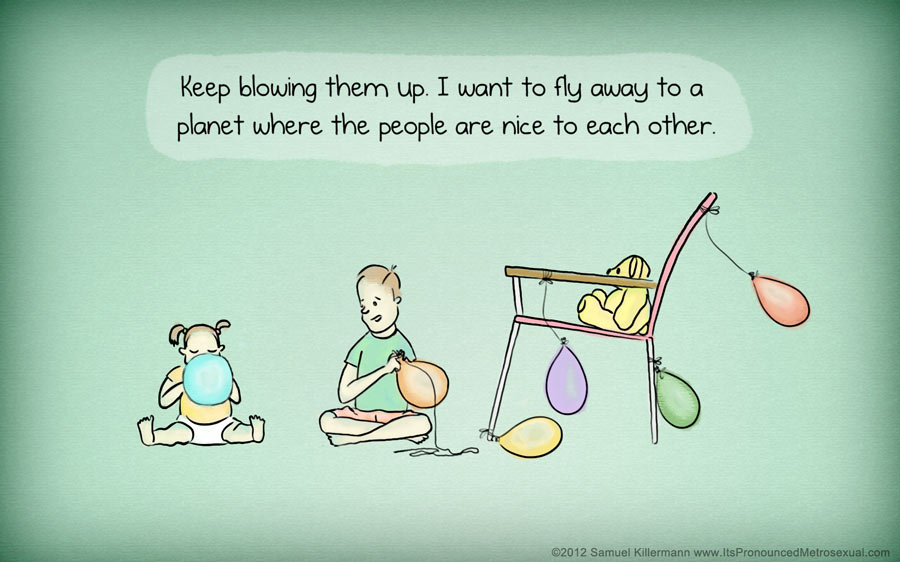
"Fly Away" Comic

Get on my mailing list!
Let’s make a deal.

Promise me that you’ll do everything in your power to read this entire article (all 800 words of it) before you start mentally formulating the comment/email/death threat you’re going to respond with.  If you can make that promise, read on.  If not, go find an website that reinforces your current dispositions on the matter and read that instead.  We’ll both be happier for it.

I’ve written a few articles about Christianity and religion, and I’ve gotten way more than a few distasteful, hateful, and often threatening emails in reply (mainly to this article, believe it or not).

But here’s the thing, folks: I’m not opposed to religion or Christianity.  I promise.  In fact, my motto is “freak what you feel.”  But I am opposed to religion and Christianity being the impetus for policy and legislation in a secular, multi-faithed society (like the United States, for example).

In a society where most people (politicians in particular) have some sort of faith that guides their decisions, it’s impossible to have a true separation of church and state.  That’s fine.  I don’t think we need to only elect atheistic representatives.  In fact, I’m candidly against that idea.

What I am suggesting is that we create and support a system where political decisions are made based on arguments that stand on their own merits without a religious crutch.  Or, to put it another way, “the Bible tells me so” is off limits as a rationale.  But that doesn’t mean what you’re arguing for will have to change.  All it means is people need to use objective, measurable evidence to defend their arguments, instead of just referring to their faith and leaving it at that.

If something is bad, or will lead to a lower quality of life for folks, or — God forbid — a “moral landslide,” explain to me why.  And do it without a single reference to dogma.

For example, a commonly-argued, religiously-slanted issue right now is marriage equality (and one you don’t have to guess my bias on).  Right now, the most compelling and popular argument against marriage equality is “marriage is between a man and a woman, because the Bible says so.”  Not okay.  You can still be opposed to marriage equality, but under the political system I’m suggesting politicians would have to debate it with secular reasoning that can appeal to people of all belief systems (like the members of their constituencies they are supposed to be representing).  A common, secular argument against marriage equality is the “same-sex parents are unhealthy for kids” one.  Fair enough.  Let’s debate that.  That’s something we can all agree is important, and something that can be approached with research and logic (and has been) to find a solution that’s best for the country as a whole.

Removing the religious crutch in political debates and discussions will do a number of helpful things:

  1. It will create a common denominator.  Many issues are so religiously loaded that it’s near-impossible for people of varying faiths to discuss them without the “discussion” turning into a “whose belief system is better” pissing contest.  Let’s yell at each other about the issues at hand instead.
  2. It will cause people on all sides to think about the issues critically.  Whether you know what is right because of your religion, or you know it’s wrong because a particular religion shouldn’t matter, knowing is the problem.  In order to have an actual debate to figure out what’s right, people need to know a bit less and be willing to wonder and examine a bit more.
  3. It will turn down the heat.  I was always taught that it’s impolite to discuss religion or politics at a dinner party.  Why is it that we think it’s helpful to merge the two into one supercharged, emotionally-unstable, multi-headed media monstrosity?  If we can separate the two concepts, at least in discourse, it’ll help — at least we’ll only be pushing one hot-button at a time.

Removing the religious crutch in political debates and discussions will also not do a number of things (consider this my pre-defense to the comments/emails I know I’m going to get):

  1. It will NOT create an immoral, Ayn Randian, dystopic society.  In fact, I would argue it will help prevent us from this.  Removing religion from political discourse doesn’t remove morality or value-based decision-making.
  2. It will NOT lead to persecution of Christians.  Unless you’re one of those who already think this is happening, in which case read this.
  3. It will NOT slippery slope now we’re marrying toasters and we elected a game of Hungry Hungry Hippos to office and other similar nonsense.  Seriously, the “slippery slope Hungry Hungry Hippos” argument is so lazy.

So that’s it.  Mull it over.  Discuss it with a friend.  Bring it up to your religious congregation.  Then, once we’re all onboard, let’s do it!

Also, if you’re going to email me (my inbox is always open), please refrain from telling me I’m going to burn in hell.  It’s not that it ruins my day reading dozens of those emails (it does), it’s just that I don’t know how to respond to them (“thanks for the heads up?”).

Written by Sam Killermann

Sam is a writer and performer who uses those skills as an ally to advance progress in the realms of LGBT equality and social justice. He tours the country speaking to college students about stereotypes, prejudice, and oppression, and writes for this site when he's at home in Austin, TX.

  • email
  • Chantal_Bichet

    It’s funny … I never agree with ANYONE on anything religious or political based.  But I am with you 100% on this one.  I’ve been saying this for years.  Anyone who doesn’t agree, clearly cannot think and argue objectively.  The hell with them. 
    - Raised Jewish, Agnostic

    • http://samuelkillermann.com/ Samuel Killermann

      Chantal, I’m happy you found someone!  And I’m happy to have your support.  Now, we just need to get all of these other jokers to catch up.

      Also, “the hell with them” was hilariously ironic.  Thanks for that.

  • Dkaytrue

    So proud of you Sam for taking the hate in stride. I feel like the real problem is that people let their religious values outweigh their logic.

    • http://samuelkillermann.com/ Samuel Killermann

      Thanks, Diana!  And I think you’re right about that.  It’s double-unfortunate that most of the religious values you’re mentioning, if one gives them a second glance, tend to generally support the ideas they are opposed to.  Oh well :)

  • Megan

    This is so logical. I love reading your stuff for that reason!

    • http://samuelkillermann.com/ Samuel Killermann

      Thanks, Megan!  I’ll keep writing it if you keep reading it.

  • Krista

     I don’t think any ONE religion should control our state/country. I do think Christianity has every place in our legislative system because our country was founded on the passions of our forefathers to have religious freedom. How can you NOT have religious values and make decisions for our entire state/country? Calling religion a “crutch” is insulting. Anyone who lives their religion knows it isn’t always easy to do what is required of them. Being immoral is easy. Don’t we want leaders that can practise self-discipline rather than doing what they want in the moment and not caring what the consequences are?  Anyone who is practising “true faith” will have passion for doing good for everyone they can…..even if they feel they can do good for 270 million people.

    • http://www.ericteske.com/ Eric Teske

      Krista, excuse me if I’m wrong, but it sounds like you’re saying atheists don’t want what’s best for the country, are not self-disciplined, only act moment to moment and do not care about consequences. As an atheist, I can say that I care deeply about this country and I want us to get along and prosper together. 

      I plan carefully for my future and I’m very aware of consequences because I don’t believe in an afterlife – which is all the more reason to make the most of the time we have here and now and live the best life possible. In fact, the consequence at the end of my life (a complete end to my existence) is ultimate, so I DO strongly acknowledge consequences. 

      My humanist values guide me, because I believe that humans are responsible for fixing their own mistakes, and caring for each other. Without a God, I believe that no one else can do it for us, so I feel a great sense of responsibility.

      • Krista

        Thank you, Eric, for responding.  When I ask this, please know it’s not condescending, but sincere interest.  I have always had a belief in God, so I don’t know of any other way thinking.  What drives you to want to live the best possible life?  We can agree that we only have one life to do our best – your’s because it ends and mine because I’m accountable to a Creator.  We are probably not like a large percent of the population.  There are many who do what they feel – sex without commitment, abusing alcohol, drugs, people, taking what they want.   There are not only hurtful consequences to society but spiritual consequences, too.  What is the purpose of life?  What is the purpose of love and companionship?  I know I won’t convince you of a God, just as you couldn’t convince me there wasn’t.  I don’t believe I emerged from an ameoba though I definitely can see devolution happening.  :P  

        • http://www.ericteske.com/ Eric Teske

          I get a little electric rush of excitement when I find someone capable of having a mature discussion, it really restores my faith (har har har) in authentic online interactions.

          Based on your comments, it sounds like you have more in common with an atheist than you might have though, and you even talk about us being different than the rest of society. First of all, I agree with you, I think there are a lot of people out there who are selfishly trying to get ahead at all costs with little regard for their fellow man. It sounds like you realize these people are made up of both religious and nonreligious individuals, as are people who seem to have discovered a purpose or philosophy of living well. So religion, in this case, is not the sole cause of trying to lead a good life. 

          Maybe religion is only one recipe for living a life of distinction, and there are other approaches that come to similar results. In fact, I believe that morals and religion do not go hand in hand. While religion strives to teach morals, it certainly doesn’t guarantee them, and it’s not to say they can’t be learned other ways – think of the thousands of children’s books each teaching an important life lesson without mention of religious themes.

          I think some morals exist as a result of living in a social society. Even apes understand the importance of sharing resources, babysitting children, alerting others of a predator even though making a sound will only draw more attention to themselves. These are selfless acts that seem to arise because they are mutually beneficial to both parties. However, I think having evolved more complex ways of thinking, we are able to refine these basic morals into a sophisticated set of social rules – and we can go a step further by imagining ideal morals, a moral goal, rather than just observing typical human behavior. 

          What is the purpose of life? We don’t know. Does there need to be a purpose?

          What is the purpose of love and companionship? Loving relationships probably improve infant survival rates and thus benefit the species – so this behavior would be reinforced over the generations because only the babies with loving parents would live long enough to have children of their own. 

          I agree that we appear to be devolving, well, “evolving” in another direction that isn’t necessarily negative but suited for survival in our current environment. I wear glasses, and there’s no way I could hunt for food in the wild without them – so normally I would die before passing on my inferior eyesight genes. Thanks to technology, I can spread my inferior eye genes all over the place where normally these inferiorities would be weeded out by natural selection (aka a lion). 

          If you want to do the evolution discussion, I’d be happy to give it a go. But really, I’m content knowing that we were able to connect like this, and that you know at least one atheist out there who isn’t a mindless drunken heathen. :)

    • http://samuelkillermann.com/ Samuel Killermann

      This country was also founded by people who thought that Black people were not complete humans, and that women were second-class citizens, and that people with mental disabilities were better dead than alive.  But none of that really matters, does it?  What matters is now.  Now we live in a country that has as many religious denominations as it does states.

      Imagine you were having a meeting with 5 people from 5 different countries who spoke 5 completely different languages.  How well would that work?  How would you conduct the meeting?  You could try to use hand gestures, but odds are it would lead to yelling/frustration/giving up.  Wouldn’t it be easier if there was a translator there?  

      What I’m suggesting here is that we require our reps and elected officials to have a translator that allows them to speak a language EVERYONE can agree on.  Otherwise we’re just going to keep yelling and hand gesturing and going nowhere.  

      And to the second half of what you said, I defer to Eric.  It’s as if he was speaking with my words before I even thought them up.

      • Krista

        Great analogy with the languages, it is so true.  That’s why in our country “majority rules” and there will always be people who are unhappy with it.  It is impossible to make everyone happy.  I do find it insulting though, when you refer to people’s belief system as a crutch, as if they were weak because they believe different to you.  It’s the same judgement you are giving as what you hate to receive.  I perceive your blog to promote acceptance.  But I think it should be reciprocated, not flinging words such as “crutch” to describe something that is important to people at their very core.  It may be Greek to you, but there are great people speaking this language, too.  Let’s work on being nice to each other on this planet.  :)   Thanks for a great conversation! 

        • http://samuelkillermann.com/ Samuel Killermann

          Actually, in our country, we have a history of tending to minority needs as well the majority.  We get better at it with each generation.  I’m sure you’re aware of that, so I’ll skip the history lessons.  But you’re right: it’s impossible to make everyone happy, particularly if you don’t even try.  It’s unfortunate you don’t want to give it a shot.  Have a little faith in humanity and you might be surprised at what happens.

          It’s unfortunate that you managed to take the word “crutch” personally.  Actually, it’s impressively unfortunate, but I suppose there had to be something to pick out as anti-religious, as much as I tried to avoid it.  People imagine water in the desert all the time, right?

          A crutch is something you lean on when your legs are weak, yes.  And in this case, what I’m suggesting is that many people are holding their arguments up with a religious crutch because they don’t have their own “feet” to stand on.  I’m talking about the arguments, not the people. 

          As I mentioned in the article, a particular religion should not be the sole argument for a policy considering we’re a secular country and we have an incredibly diverse populace.  Only about half of Americans go to a religious service every week, about the same pray to a god, and the numbers of atheists and agnostic folks are increasing dramatically with each year.

    • Alex

      let me direct you here on why I believe that religion should be separate from government, and why the founding fathers didn’t mean it they way most think they meant it.

  • Agnostic Neighbor

    Lovely article. Very well thought-out and articulated. It infuriates me when people refuse to see the bigger picture, refusing to discuss anything other than what ‘pastor ryan’ talked about last Sunday in regards to  marriage equality or abortion or whatever the real-life subject of the day is. Elected officials religious values should not dictate how the rest of us live. I am not religious but I am moral. Being a good neighbor, good citizen and good friend should be enough.

    • http://samuelkillermann.com/ Samuel Killermann

      I think it would be fascinating if this type of thinking was actually fully embraced.  The entire scene in Washington would have to shift in, what I think, would be a very positive direction.  We’d get to witness actual conversations about policy, instead of these ridiculous chess games of politics and power.

  • Pingback: Religion should not be a factor in making political decisions. - christianfamiliesnetwork.com - christian families network

  • Joe Irvine

    “Removing religion from political discourse doesn’t remove morality or value-based decision-making.”
    Actually, it does if your entire argument is based on religious beliefs (morals and values). In these cases, anything that isn’t your religion is immoral or lacks “family values”. The problem is “morals” are defined by society, and more importantly, people individually. One person’t morals do not necessarily match those of another because they were raised differently. This doesn’t make them wrong (although many religious types would disagree with me), it just makes them different. 

    What needs to happen is religion needs to learn tolerance, as opposed to the nazi state thinking that many religious types like to use.

    • http://samuelkillermann.com/ Samuel Killermann

      Thanks for the comment, Joe, but I disagree.  I think that you can take religion out of the debate without removing the morals or values one learns from religion.  I hold a lot of traditional Christian values and morals and use them to make decisions, even though I’m not Christian nor would I ever cite Christianity in my decision-making (ditto modern Buddhism).  You simply take out the rules but leave in the rationale.  The rationale is where the common ground and debate come in.

      I do agree that many religious folks could do with a bit more tolerance, but that goes for most everyone, doesn’t it?

  • Pingback: What’s Life All About? | Fish Oil Truth

  • ashearer1

    Very nicely put, Sam. I love the analogies you create;  it’s effective for illustrating your point, but it doesn’t pander or condescend to your audience. 

    Ever thought of running for political office? ;) ?

    • http://samuelkillermann.com/ Samuel Killermann

      Ha – I’ve thought about it, but there are already a ton of people in office who are way funnier than I am.  I don’t think I’d make it past the initial attack ad phase :)

  • Pingback: “Fly Away” Comic

  • exprudentiavirtus

    As one who’s spirituality is loosely framed within Christianity, this doesn’t bother me one bit. Religion doesn’t have a place in politics in a multicultural society–we have to make sure our laws are defined by reason, so that they rightfully apply to ALL Americans. One can use their faith’s emphasis on being a good person to help them endeavor to make the right/best decision, but this should always lead us towards a logically sound and ethical solution determined by facts, not fables.

  • lynn

    You are anti Christian People’s religious views are as much a part of them as their preferences for Coke or Pepsi. You are an IDIOT.

    • Be mature, here.

      come on. You went ahead and used improper language to express yourself. you know that for a large portion of christians, that’s just simply not true. you have to be able to separate you religion from social life, otherwise you’re more or less a robot, never changing ideas, never doing anything other than what your religion tells you to do.

      also, my preference for coke and pepsi change frequently. I wouldn’t call that very concrete, to be honest.

  • http://blogdemigue.com/ Miguel Ángel García Calderón

    I do not think “deserve” burn in hell. Your proposal seems the most sensible and consistent I’ve read.

    It is valid and have no reason to deprive persons having or not a belief in a deity, but it is not justifiable is the fact that these beliefs is handled with the masses.

    Greetings and congratulations on the article.

    • http://samuelkillermann.com/ Samuel Killermann

      Thanks for the appraisal, Miguel. Share it with a friend and see what they say.

      • http://blogdemigue.com/ Miguel Ángel García Calderón

        Maybe for someone obsessed with the idea of religion will be complicated, but for a sane person think I should not have much problem.

        Greetings!

        Pd. – I hope keep in touch =)

  • Tallinn

    OK, I’m a practicing catholic but I live in France and you american people confuse me. What I read here seems just like common sense, why is that even a problem? You
    can’t include one religion in the politics of a multicultural country
    without alienating a part of the population…
    I think religions can help because we might have some kind of basic understanding on what is
    right and wrong… You know, don’t kill, don’t steal, that kind of
    thing. But when you don’t have real arguments behind it like in the case
    of homosexuality you can’t push some arbitrary rules on the population
    by saying it’s written in the Bible. A lot of things are written in the
    Bible. A lot is good and inspiring, some of it creeps me out. Religion
    is something very personal. You don’t push it down people’s throat like
    that. Some things got to be consensual, you know. :)

  • http://www.facebook.com/matthew.hervert.3 Matthew Hervert

    “A Republic, madam, if you can hold on to it!”
    - Benjamin Franklin, responding to a lady in a crowd, who, at the close of the Constitutional Convention, called out, “Mr. Franklin! What kind of a government have you given us?!”
    - Sept. 17, 1787

    The system you suggest did exist til democracy came. The problem with Democracy is that it permits rights to be up for debate. The majority shall always have outcast. Telling the religious their place is the same as them telling us ours, neither is fair. Further who would the politicians represent if there scope of representation is confined? We all seem to have a predilection to bring about our beliefs of what right by forcing the conformation of the unwilling. Lastly, while functionally your correct saying things like religious crutch is diminutive and inflammatory.

    “Problems cannot be solved by the same level of thinking that created them.” Einstein

    Ps I think your great, lol. Thanks!