IPM on Kickstarter

Breaking through the binary: Gender explained using continuums

by Sam · 109 comments

in Gender

Update: View the new-and-improved Genderbread Person v2.0.  It’s a heckuvalot better and just as free!

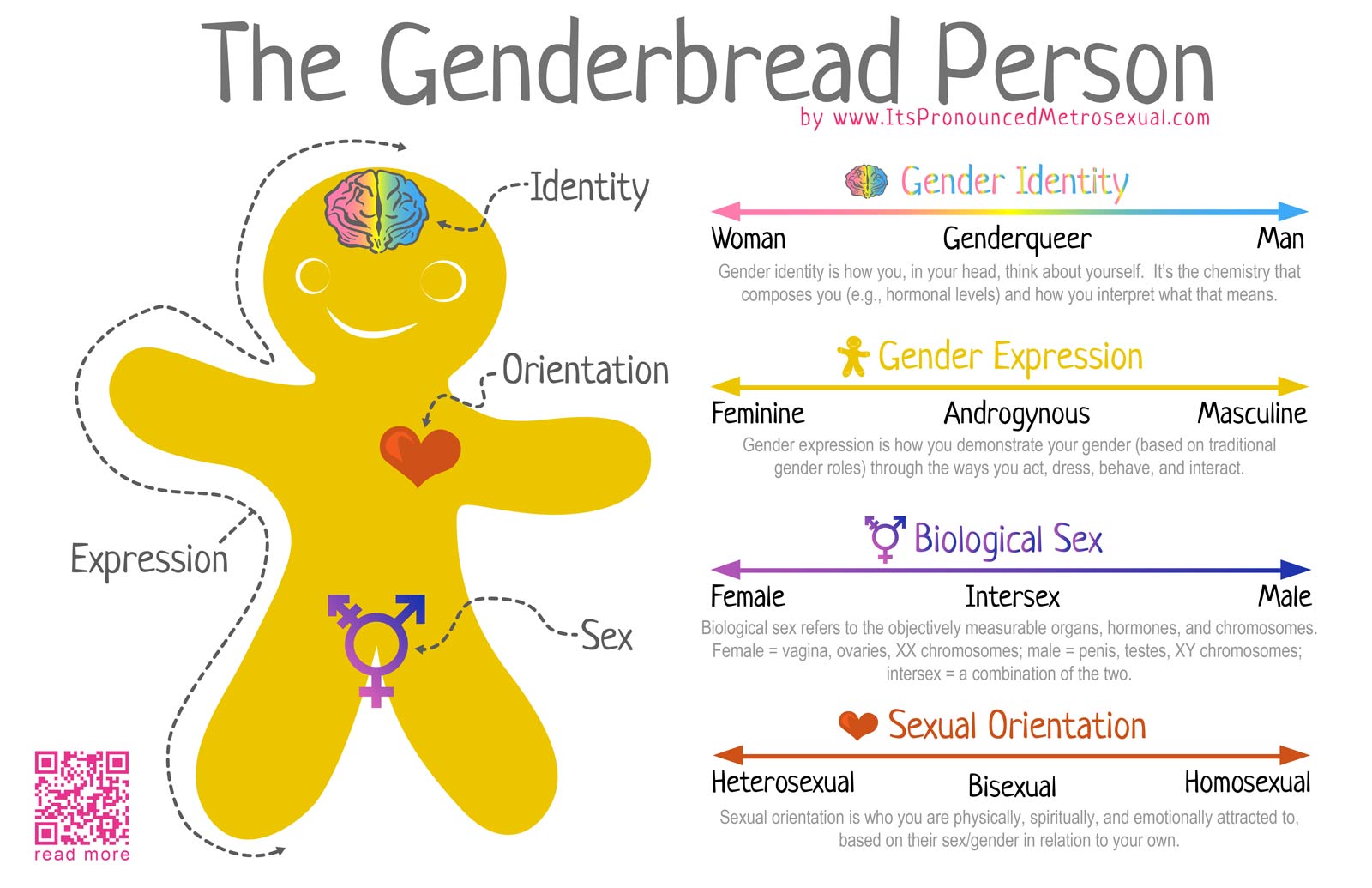
Gender is a tough subject to tackle.  There are a lot of facets to consider, a lot of pressures at play, and we have all been conditioned in such a way that our first instinct is almost unanimously wrong.  But we’re going to tackle it.  No, we’re going to tackle the balls out of it.  Coming to our aid, I would like to present to you: The Genderbread Person!
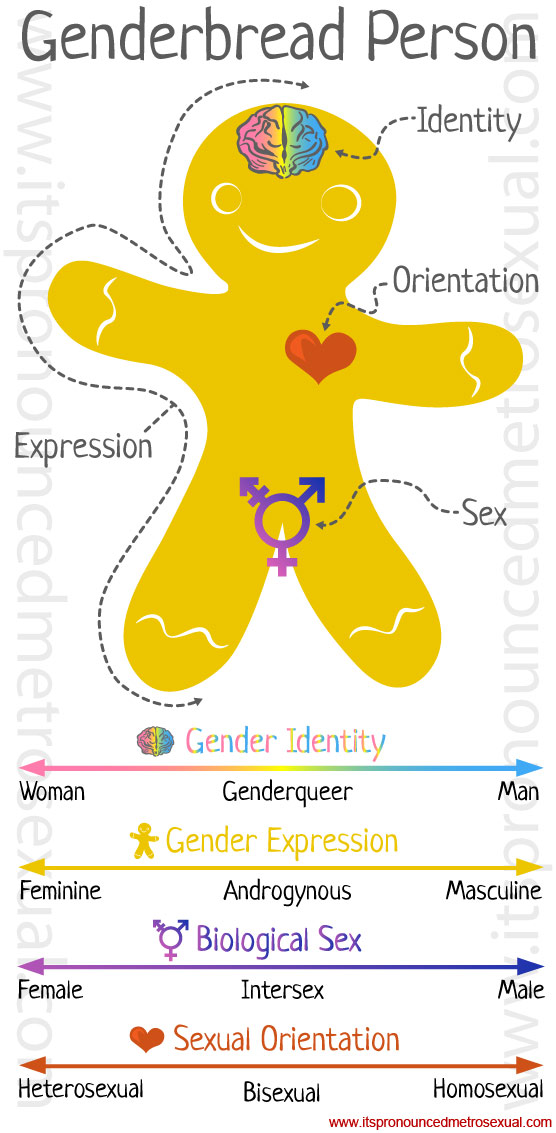
Genderbread Person: Gender Identity Explanation Graphic

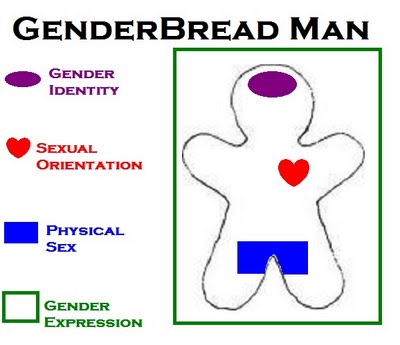
Genderbread PersonI was first introduced to the Genderbread Person through Tumblr, a fun, and sometimes informative, microblogging platform.  Then I saw another version (pictured right) somewhere else on the web.  There are also a few other versions floating around, but they all have their issues.  I wanted to create a new and improved Genderbread Person, so I did.  Now let’s talk about it.

The Genderbread Person

As you’ll see above, we have four elements.  I will break those down, but first I want to talk in generalities.  First of all, if you noticed that the first three categories all pertain to gender, while the fourth pertains to sexuality, great job.  Skip ahead to the next paragraph.  For everyone else: if that doesn’t make sense to you, or you’re unsure of how all four interrelate, worry not.  By the end of this post it’ll all make sense or you can have your money back.  And if you never gave me money, give me money.

Support IPM by buying a T-Shirt
Whenever I talk to groups about gender, a common problem arises: people tend to assume that someone has to be on either the left half or the right half of all the continuums above, and when I explain that many people zig zag through the list, they give me blank stares.  I’m about to say something that will likely freak you out, but be cool, because it’ll all make sense soon.  Gender identity, gender expression, biological sex, and sexual orientation are independent of one another (i.e., they are not connected).  With that said (I’m going to say it again later), let’s move on.

Gender Identity: Who You Think You Are

Genderbread Identity

On the left we have “woman” and on the right we have “man,” two terms you are likely already familiar with.  In the middle, we have the term “genderqueer,” which, you guessed it, is used for an identity that is somewhere between woman and man.  Another term for genderqueer that is accepted within the community is “genderfuck,” but that’s a bit racy for my taste.  It’s also important to note that many people consider their identity to fall outside of the traditional (and limited) woman to man spectrum.  These identities can be called genderqueer, agender, third-gender, bigender, and more.

Gender identity is all about how you, in your head, think about yourself.  It’s about  how you internally interpret the chemistry that composes you (e.g., hormone levels).  As you know it, do you think you fit better into the societal role of “woman,” or “man,” or do neither ring particularly true for you?  That is, are you somewhere in-between the two?  Or do you consider your gender to fall outside of the spectrum completely?  The answer is your gender identity.

It has been accepted that we form our gender identities around the age of three, and after that age it is incredibly difficult to change them.  Formation of identity is affected by hormones and environment just as much as it is by biological sex.  Oftentimes, problems arise when someone is assigned a gender based on their sex at birth that doesn’t align with how they come to identify.  We’ll talk about that more later.

Gender Expression: How You Demonstrate Who You Are

Genderbread Expression

On the left we have “feminine” and on the right we have “masculine,” the two expressive terms related to “woman” and “man.”  In the middle, we have a new term “androgynous,” which describes an ambiguous or mixed form of expressing gender.

Gender expression is all about how you demonstrate your gender through the ways you act, dress, behave, and interact–whether that is intentional or unintended.  Gender expression is interpreted by others perceiving your gender based on traditional gender roles (e.g., men wear pants, women wear dresses).  Gender expression is something that often changes from day to day, outfit to outfit, event or setting to event or setting.  It’s about how the way you express yourself aligns or doesn’t with traditional ways of gendered expression.  And like gender identity, there is a lot of room for flexibility here.  It is likely that you slide around on this continuum throughout the week without even thinking about it.  How about an example?

You wake up and you’re wearing baggy grey sweatpants and a tshirt.  As you walk into your kitchen to prepare breakfast, you’re expressing an adrogynous-to-slightly-masculine gender.  However, you see your partner in the kitchen and you prowl in like Halle Berry from Catwoman, then you are expressing much more femininely, so now you’re back on the left half of the continuum.  You pour a bowl of cereal, wrap your fist around a spoon like a viking, and start shoveling Fruit Loops into your face, and all-of-a-sudden you’re sliding back onto the right side of the continuum.  After breakfast, you skip back into your bedroom and playfully place varying outfits in front of you, pleading your partner help you decide what to wear.  You’re feminine again.

I assume this entire time you were imagining it was you, with your gender identity, acting out that example.  Now go through the whole thing, but imagine someone with the a different gender identity from you going through the motions.  Now you are starting to understand how these concepts interrelate, but don’t interconnect.

Biological Sex: The Equipment Under the Hood

Genderbread-Sex

On the left we have “female” and on the right we have “male,” the two biological sexes we all grew up knowing about.  In the middle, we have a new term “intersex,” which describes someone whose sexual organs are not strictly male or female.  The term “hermaphrodite,” which you’ve likely heard used to describe an intersex individual, is frowned upon as “hermaphrodite” is a stigmatizing word that means someone who is entirely male and female, a biological impossibility.  P.S. How did you feel about me expressing my masculinity in the heading of this section?

Biological sex refers to the objectively measurable organs, hormones, and chromosomes you possess.  Being female means having a vagina, ovaries, two X chromosomes, predominant estrogen, and you can grow a baby in your stomach area.  Being male means having testes, a penis, an XY chromosome configuration, predominant testosterone, and you can put a baby in a female’s stomach area.  Being intersex can be any combination of what I just described.

For example, someone can be born with the appearance of being male (penis, scrotum, etc.), but have a functional female reproductive system inside.  There are many examples of how intersex can present itself, and below you can see some statistics from the Intersex Society of North America that describe the frequency of intersex births. (check out the stat I bolded, but be prepared to be shocked)

Not XX and not XY one in 1,666 births
Klinefelter (XXY) one in 1,000 births
Androgen insensitivity syndrome one in 13,000 births
Partial androgen insensitivity syndrome one in 130,000 births
Classical congenital adrenal hyperplasia one in 13,000 births
Late onset adrenal hyperplasia one in 66 individuals
Vaginal agenesis one in 6,000 births
Ovotestes one in 83,000 births
Idiopathic (no discernable medical cause) one in 110,000 births
Iatrogenic (caused by medical treatment, for instance progestin administered to pregnant mother) no estimate
5 alpha reductase deficiency no estimate
Mixed gonadal dysgenesis no estimate
Complete gonadal dysgenesis one in 150,000 births
Hypospadias (urethral opening in perineum or along penile shaft) one in 2,000 births
Hypospadias (urethral opening between corona and tip of glans penis) one in 770 births
Total number of people whose bodies differ from standard male or female one in 100 births
Total number of people receiving surgery to “normalize” genital appearance one or two in 1,000 births

Sexual Orientation: Who You Are Attracted To

Genderbread Orientation

On the left we have “heterosexual,” meaning attracted to people of the opposite sex, or being straight.  On the right we have “homosexual,” meaning attracted to people of the same sex, or being gay or lesbian.  And in the middle we have bisexual, meaning attracted to people of both sexes.  Note: there is no place on the scale for “asexual”, which is the lack of sexual attraction to others, as it doesn’t fit into this continuum.

Sexual orientation is all about who you are physically, spiritually, and emotionally attracted to.  If you are male and you’re attracted to females, you’re straight.  If you’re a male who is attracted to males and females, you’re bisexual.  And if you’re a male who is attracted to males, you’re gay.  This is the one most of us know the most about.  We hear the most about it, it’s salient in our lives, and we understand where we stand best.  It’s pretty cut and dry, right?  Maybe.

Interestingly enough, pioneering research conducted by Dr. Alfred Kinsey in the mid-20th century uncovered that most people aren’t absolutely straight or gay/lesbian. Instead of just asking “do you like dudes or chicks?” (very sciency, I know), he asked people to report their fantasies, dreams, thoughts, emotional investments in others, and frequency of sexual contact.  Based on his findings, he broke sexuality down into a seven point scale (see below), and reported that most people who identify as straight are actually somewhere between 1 – 3 on the scale, and most people who identify as lesbian/gay are 3-5, meaning most of us are a little bi-.

0 – Exclusively Heterosexual
1 – Predominantly heterosexual, incidentally homosexual
2 – Predominantly heterosexual, but more than incidentally homosexual
3 – Equally heterosexual and homosexual
4 – Predominantly homosexual, but more than incidentally heterosexual
5 – Predominantly homosexual, incidentally heterosexual
6 – Exclusively Homosexual

Putting it all together.

Wow, that was a lot of information all at once, can we agree?  The crazy part: I held back.  I plan to write individual write-ups on each of the sections above, because there is still so much to say.  But you don’t need to worry about that right now.  We need to make this all make sense–synthesize some knowledge up in your brain.

Interrelation versus Interconnection

Remember earlier when I said that thing, then I said I would say it again?  It’s on the right, in case you forgot.  This me saying that again: though the four things I presented above are certainly interrelated, they are not interconnected.  What do I mean by that?

Gender identity, gender expression, biological sex, and sexual orientation are independent of one another (i.e., they are not connected).People’s sexual orientation doesn’t determine their gender expression.  And their gender expression isn’t determined by their gender identity.  And their gender identity isn’t determined by their biological sex.  And also every other mismatch of A isn’t determined by B combination you can dream up from those inputs.  Those things certainly affect one another (i.e., they are related to one another) but they do not determine one another.

If someone is born with male reproductive organs and genitalia, he is very likely to be raised as a boy, identify as a man, and express himself masculinely.  We call this identity “cisgender” (when your biological sex aligns with how you identify) and it grants a lot of privilege (read some of them in this list of cisgender privileges).  It’s something most of us who have it don’t appreciate nearly as much as we should.

Questions, Concerns, or Thoughts?

Take some time to mull all of this over, particularly if it’s the first time you’re learning about this super-complex, super-hard-to-swallow subject.  There’s a lot of information to process, and most of it goes against a lot of what you might have been learned growin’ up.

Also, feel free to use the comments on this post to discuss, ask questions, or provide different insights to what you read above.  Heck!  That’s what they’re there for!

And as always, get in touch if you have any questions you’d rather not ask in an open forum.  I’m always willing to help, if I can.

Written by Samuel Killermann

Sam is a writer and performer who uses those skills as an ally to advance progress in the realms of LGBT equality and social justice. He tours the country speaking to college students about stereotypes, prejudice, and oppression, and writes for this site when he's at home in Austin, TX.

  • Pingback: List of Cisgender Privileges | It's Pronounced Metrosexual

  • Pingback: Defining a “Metrosexual Male” | It's Pronounced Metrosexual

  • David

    Interesting stuff! Reminds me of a lot of what we talked about in my women’s psych class. Did Zak ever tell about the time we cross dressed for a day on IUSB’s campus?

    • http://samuelkillermann.com Samuel Killermann

      Thanks, David! It is interesting. I could write another 2000 words on each subheading above.

      And nope, Zak never mentioned that, but it sounds like a great experiment. Was your appearance feminine enough that people assumed you were women?

      And thanks for reading!

      • Quiet riot girl

        I actually see the ‘lines’ you draw from male to female, man to woman, masculine to feminine, more like a circle.

        The ‘binary’ is not REAL it is something we construct in our heads to try and make gender, which is very complex, into something simple.

        So femininity for me coincides with, overlaps with, leads to, relates to masculinity and vice versa.

        I am not an artist I don’t know how to draw it!Also I think *everything* to do with sex and gender happens in our minds as much as anywhere else so if it were me I’d put more than just ‘identity’ in the head part. I’d put orientation, sex, presentation, etc there too.

        Thanks for asking for feedback it’s a great idea and I have a lot of respect for you and your work.

        • http://samuelkillermann.com/ Samuel Killermann

          QRG, I really REALLY wanted to do circular continnums instead of linear ones, to further illustrate the fluidity of everything, but once I started drafting things up I realized circles are no better (and more flawed, actually) than lines.  Then I found myself doing venn diagrams, and compound venn diagrams, and I realized I might have to concede accuracy for legibility.

          I’m not done writing about this stuff.  I have a few more posts planned to build upon each of the topics above.  It’s tough, though, and challenging, but in the best of ways.  It’s laborious stuff, writing for the internet.  I never struggled so much to write in grad school, because only one person was going to criticize/analyze my writing, not 500,000 people.

          I’ll get there.  I’m learning a ton about the teaching of this stuff from comments and emails, which is fantastic.  

  • http://saitoutloud.blogspot.com Eric Teske

    This page is turning into quite the resource!

    • http://www.samuelkillermann.com Sam

      What makes you say that, sir? (also, thanks! That’s the goal for the site, so it’s great to make some progress)

    • http://samuelkillermann.com Samuel Killermann

      What makes you say that, sir? (also, THANKS! That’s the goal for the site, so it’s great to be making some progress)

    • http://samuelkillermann.com/ Samuel Killermann

      When you wrote this comment a month ago, did you know that it was the beginning of a slow-burn that would result in this image being viewed 200K+ times?  If so, I’m impressed.

  • Anonymous

    The labels heterosexual and homosexual are meaningless for intersex people

    • http://samuelkillermann.com Samuel Killermann

      That’s a great point.  But what would be a more appropriate label for intersex people?  Any suggestions?

      • Kittyavatar

        Heterosexual and homosexual can still apply to intersexed people, depending on the gender identity. Or where you fall on the spectrum.  
        If you are raised male and think of yourself as male and then find out later in life that you are in fact intersexed then being sexually interested in females means you can still be hetero.  

        Or if you are mostly female then you would be homosexual if you like other females.  Since it is a spectrum there is some wiggle room. 

        • http://samuelkillermann.com/ Samuel Killermann

          I think the point zyxw was trying to make is that the labels themselves (not the meaning implied by them) are meaningless.  That is, homoSEXual and heteroSEXual literally mean people with the same or different sex – a semantics argument.

          But you are completely right: sexual orientation has more to do with gender identity than it does bio sex, at least in terms of internally IDing oneself gay/straight.

          • Hrunter

            Some of the ones I’ve come across in the Trans* community that don’t specify the sex/gender of the… labelee?  person making the orientation assertion.  These also don’t limit an orientation a specific sex, but includes associated identities and expressions :D
            Androsexual/Androphilic (Likes men/males/masculinity)
            Gynesexual/Gynephilic (Likes women/females/femininity)
            Skoliosexual (likes non-binary/genderqueer/trans-identified persons or expressions)
            Pansexual (Likes people regardless of physical sex, identity or expression)

          • http://samuelkillermann.com/ Samuel Killermann

            Hrunter, I’m really happy you brought that up.  I’m planning a post “Sexual Orientation for the Genderqueer” (something like that) in an attempt to sail those murky waters.  

            I didn’t think it was appropriate to include here, because I wanted this post to be beginner friendly, and not too overwhelming, but as I write more-detailed posts about each aspect, I’ll include “read more if you’re up for a challenge” links.

      • Francisco Leonardo O. G.

        The continuum could go from “attracted to men” to “attracted to women”, but then again, it’s not that simple. For example, I am attracted to males (i.e. I like penis, I don’t like vagina), but I certainly prefer kind of androgynous boys (I like them slim, I don’t find big muscles or beards very attractive). I think sexual orientation could be as well measured in different interrelated but not interconnected features.

  • Jack Skellington

    Excellent post, sir. I was trying to explain all this to one of my friends (in relation to my own genderqueer-ness) for about 20 mins the other day, then remembered seeing a link to this article on the Genderqueer facebook page. She got it immediately (then we proceeded to discuss fashion for another hour or so LOL).

    • http://samuelkillermann.com/ Samuel Killermann

      Thanks for the comment, Jack!  I’m happy you remembered it, and managed to find it again, but I’m most happy it came in handy for you.  Mind linking me to the genderqueer facebook page you’re talking about?  

      Also, I enjoy your work, as well.  I’ve had “What’s This” stuck in my head since middle school ;)

      Hope you keep reading!  Let me know if there’s anything else I can help with.

  • Pingback: The Genderbread Person: a helpful visual aid for explaining gender | It's Pronounced Metrosexual

  • Blinkyblueyes

    This should be taught in sex education in every school… :) i wish it had been in mine!

    • http://samuelkillermann.com/ Samuel Killermann

      Well now you know it’s here for any future sex education you might find yourself doing!

  • noct Scottish

    I had a problem with the hetro-homo as well i would recommend having a scale going from girl to guy(or more appropriate terms just referring to gender) and ones attraction to them.

    • http://samuelkillermann.com/ Samuel Killermann

      I think something like that is a great suggestion.  In an effort to keep the graphic simple, and with a focus on gender, not sexual orientation, I kept it to using terms that most people would understand (hetero/homo/bi).  Based on suggestions I’ve received, I’m working on a revision that will be more pan-/asexual friendly.

  • K-G

    Thanks for giving this topic, and this diagram, more visibility. I’m wondering, though, what it is you don’t like about the simpler presentation that you’ve made into your “new and improved” version. I had seen the ones with the “scales” next to them as well, but I choose to use the simpler version when I teach this concept in sex ed because no matter what you say, the visual of woman-feminine-female all “going together” and of man-masculine-male all “going together” on those scales is pretty hard to overcome. We present the genderbreadperson graphic and discuss the concepts. 

    I certainly agree that yours is prettier than the one I use. I’d love to hear more about the substantive reasons you prefer the changes you’ve made. 

    • http://samuelkillermann.com/ Samuel Killermann

      Great question!  Here are a few reasons:

      1. A lot of the versions I had seen were labeled clumsily.  The labels male/masculine/man and female/feminine/woman are important for separating the constructs, and many models I’ve seen blur these together (e.g., male/female for gender identity).  When explaining something is SO dependent upon clear, intentional use of language to be successful, I think it’s important to start the conversation using a model that is clear.

      2. A lot of the versions I’ve seen don’t have spectrums, or had tic-marks on the spectrums.  Spectrums are important for conveying the fluidity of identity, and removing the conventional binary-limited perspectives.  The lack of tic-marks implies an infinite number of possibilites, instead of seven, ten, or however many tics are presented.

      3. The one I show above is called “Genderbread Man.”  Hilarious as it might be, the idea of starting a discussion about how complex gender can be using a gender-slantedly-titled model isn’t wise.

      4. Also, mine’s prettier :)  And joking aside, its well known that people associate form with function.  People are more likely to take notes from a well-dressed professor standing at a lectern than a shabbily-dressed person sitting on the ground beside a bus stop, even if it were the same person dressing the two parts.  Google “Joshua Bell plays the metro” if you disagree.  

      • K-G

        Ooh — tic marks! Yuck, yuck, yuck! But there’s still that issue of the male-masculine-man visual, and the female-feminine-woman visual. This whole thing has me thinking about a revision to my own version (which, by the way, I made MUCH prettier than the ones I’d seen previously — I agree that presentation is important). There’s still a ways to go to pretty it up but the basic idea is a fishbowl with all the terms swimming harmoniously together. It has the additional value of allowing more than two (binary) or three (graduating continuum) terms per section. And it would allow more than one term per idea, and would allow room for some terms that might be more familiar, such as “tomboy.” 

        The fishbowl idea has been swimming (if you’ll pardon the pun) around in my head in response to all those Jesus fish and Darwin fish on people’s cars. My father-in-law has one of a Jesus fish eating a Darwin fish. There are plenty of religions that endorse science and so this idea that Jesus and Darwin could coexist peaceful had been coming to me as the two car-fishes swimming together in a bowl. It’s a work in progress. I’ll play with it a little and see if it develops into anything actually useful. 

        I hadn’t caught the “Gingerbread MAN” part… you’re right. That’s awful. 

        And one last thing — no matter how pretty I make it, I’ve still yet to have a single teenager actual take one with them. They always leave them in a pile on the table on their way out the door. :)  

        • http://samuelkillermann.com/ Samuel Killermann

          I think I might not be fully understanding what you mean by the female-feminine-woman visual.  Can you explain that a bit more? Does our graphic here have that strength, or is it lacking it?

          And I think the fish idea has some promise, but I’m concerned by one image that I keep getting hooked on (you’re welcome for the pun).  Fish in a bowl implies to me the idea that one can reach in and choose their orientation – it implies preference.  It also creates the illusion that orientation is a discrete thing, limited to the seven, ten, or fifty fish that are in that bowl, when it’s much more varied than that.  There is no set-form “straight person” just as much as there is no set-form “gay”, “lesbian”, or “bi-” person.

          I have been working on a revision of the sexual orientation aspect of the graphic.  Perhaps you’d be willing to provide me some criticism.  I think that what I have here is much better than what I had, but I’m not sure if it’s GOOD yet.  Thoughts?

  • Julie

    I would recommand using the terms ‘sexual orientation and/or preference’ to include people who chose to be in a relationship with someone there own gender or someone of the oposite gender or with someone who is transgender, transexual (male to female, female to male) or queer. The term orientation is very essentialist and though some people feel they are born with a strong attraction to a specific gender, others have at some point in their lives chosen to be with someone of a specific gender. If we understand attraction outside of heteronormativity, then idea of ‘chosing’ to be attracted to the gender of our partner should not be seen as problematic.

    • http://samuelkillermann.com/ Samuel Killermann

      The problem with the word “preference” is that this whole subject is currently hot-button political.  ”Preference” lends itself to the argument that same-gender-loving is a choice, which lends itself to the argument that it can be “fixed” or shouldn’t be protected by the gov’t.  

      The last thing I want to do is pull a Cynthia Nixon and provide the anti-LGBT folks with ammunition.

      As you said, if you understand attraction and identity outside of heteronormativity, this wouldn’t be an issue.  But, unfortunately – at least for now – we live in an incredibly heteronormative society and world.

      • OneGuy

        but i hope you see that making cynthia nixon ‘ problematic’ is problematic in itself. in what democracy, exactly, is it OK to require “no choice” in order to argue for protections? the problem isn’t that some people feel born this way or to have chosen it, the problem is that we are creating dangerous legal precedents for who deserves protections.

  • Pingback: The Genderbread Person » TransEnough.com

  • Britt Reed

    Dear Sam,
      I used to teach something similar to this in my High School Gay/Straight Alliance, but the way you have explained each subject is absolutley incredible. If you are alright with this, I would love to use in in this year’s Colorado GSA Summit in Denver. I am teaching a class on what it means to be genderqueer and I think that using your definition would benefit all those who are involved. Let me know what you think via email, brittreedharden@gmail.com
    Thank you Again!
    Britt Reed

    • http://samuelkillermann.com/ Samuel Killermann

      Britt, I sent you an email because I’d love to chat more, but for anyone else reading this, the short answer is YES.

  • Pingback: The Genderbread Person | Token Skeptic

  • Pingback: Quickies: 02/01/2012 - Queereka

  • Pingback: Slap Upside The Head: The Genderbread Person

  • Mym

    I hate the conceit that my “sex” is determined by my crotch. I have one set of plumbing, a different set of hormones, and no one in the world actually knows my karyotype; yet I cannot claim to ‘intersex’, that would be appropriating a set of issues from people who have had to deal with things like genital mutilation as a child to make them look “normal”. I cannot accept the idea that my “sex” is set one way forever, despite all social interactions and cellular biology to the contrary, unless I can drum up a few thousand dollars and submit to a knife to magically cross that invisible line.

    • http://samuelkillermann.com/ Samuel Killermann

      And I don’t think you should conceit to that, Mym.  In the article, I describe that sex is determined by repro organs, chromosomes, and hormones – much more than just what’s “between your legs.”  And many even go further to say sex is hair, body hair, leg length, hip width, tone of voice, and more.  I kept it simpler for this article, to be more appropriate for people first breaching this topic, but that is not to say that if you have genitals that appear to match the rest of you you aren’t intersex.  As is the case with all of this stuff, nothing is ever that cut and dry.

      • Diane Schluter

        I would say that sex is that an anthropologist with DNA evidence (for inter-sex) could find from your 500 year old skeleton, but that’s probably morbid….

        • http://samuelkillermann.com/ Samuel Killermann

          That’s true, to an extend.  One could find bio evidence of certain aspects of sex on a 500 year old skeleton.  If you subscribe to the idea that sex is determined solely by karyotypes, then yes, that’s true.  But if you subscribe to the idea that sex, much like gender, is more constructed and subjective, weighing all those other things I mentioned (body shape, hair, etc.), it’s a bit more difficult.

  • Pingback: Gender and Sexuality Life Lessons from the Genderbread Person (Infographic) | Gay Blog | Gay News

  • Joe Irvine

    Thank you, Thank you, Thank you! T His is perhaps the best post I have ever reat that expresses this concept!

    • http://samuelkillermann.com/ Samuel Killermann

      Well thank you, Joe.  I appreciate the kind words and am happy to see it going to such good use.

  • http://www.facebook.com/finmagik Alexandra Moore

    You seem to have forgotten asexual.

    • http://samuelkillermann.com/ Samuel Killermann

      Not forgotten, no, just marginalized.  This is a post more about gender than sexual orientation, and I was trying to keep it as simple as possible.  Also, asexuality doesn’t fit within that spectrum, so I decided not to include it.  

      That is all to say that I don’t live without regrets, and this is one of them.  I’m working on a way to make the orientation part of the diagram more inclusive, and I’ll be posting an update once I do, with an apology to all of my asexual and pansexual readers.

  • Pingback: Improving the Genderbread Person: I need YOUR help | It's Pronounced Metrosexual

  • Pingback: Cheryl's Mewsings » Blog Archive » Worth A Thousand Words

  • Melissa R.

    Forgive me for sounding rude, or for labeling homosexuality as a disease, but is it in any way preventable? If you have ever found out that you yourself are gay, is that how it is for you then?

    • http://samuelkillermann.com/ Samuel Killermann

      No worries on sounding rude, Melissa.  I want this to be a safe space for all questions and viewpoints, not just those agreeing with me.  In fact, I prefer the latter most of all.

      There’s a lot of research, and a LOT of opinions on what you just asked.  Depending on who you ask, or what research you read, you’ll get a different answer.  But you asked me, so here’s mine:

      You don’t choose your gender identity or sexual orientation, no more than you choose your race or hair color.  It’s something that is imbued into you, though a potent mixture of hormones at birth and in early years.  Did you know that the only thing that makes a girl look more like a girl than a boy (wider hips, breasts, etc.) is estrogen?  

      You do choose, however, how you express your gender identity and sexual orientation.  You’ve likely heard the term “in the closet,” used to describe gays/lesbians/bisexuals/pansexuals who pretend to be straight to fit into the norm.  It’s a horrible, terrifying, restrictive, damaging way to live a life, yet some people feel so pressured to hide who they truly are that they stay in the closet for thirty, forty, fifty years, or even their entire life, never “coming out” and exposing their true identity.

      Now let me ask you a question.  If being gay or transgender was a choice, do you think the subgroup of people I just mentioned would choose to live in hiding as lgbt, or just choose to be straight instead?

      Something to mull over.  Thanks for reading, Melissa, and thanks for your question!

      • Melissa R.

        Thank you so much to replying to me, and I am so sorry that that I am this late replying back. But I have heard (and agreed) with the fact that a person unknowingly has homosexuality happen upon themselves. Someone while growing up takes in their surroundings on how they are to develop.

        For instance, a young girl, living with other girls, is being shown inappropriate images on accident (i.e. from dressing, in clothing, television)and will over time be attracted to girls when they are older. Once they of age, and they go into puberty, the innocent blushing, they had when younger becomes a permanent change to when they are older as to who they are attracted to. It may not be that much when they are pre-pubescent though; their hormones haven’t even thought to begun. It’s only when they do start is when those certain feelings kick in.

        It made me think that it is that person’s doing, without them even realizing it. The young girl grows up, realizing that she doesn’t like boys because of her household; that her body unknowingly accepted such feelings. It made sense to me for the reason it times in with a child’s  changing bodily functions. I never understood it but that is my best guess, and it might even be a part of it. That’s the reason why I asked if it might be preventable in the first, because avoiding such an environment while prevent those feelings from sprouting in the first place.

  • http://twitter.com/ibleedincolor Rebekah

    This is a great tool for explaining all the differences! I decided to do a speech for school on Gender and Sex after I overheard a classmate ask if there really was difference between the two. Your illustration is quite useful!

    • http://samuelkillermann.com/ Samuel Killermann

      Rock that speech, Rebekah!  And feel free to print out little gingerbread people for all of your classmates – the pinter-friendly version is designed just for that.

  • Rbclayton

    I recently had a very long discussion with my pastor about this very issue. He’s straight (I’m not) and very open and accepting of gays (unusual, I know). He’s had gay friends in the past but non were really willing to sit down with him and have a frank and honest discussion about this topic. I, on the other hand, have no problem talking about my homosexuality. I wish I had had a copy of this when I had the discussion with him, bit now that I have it, I will make sure he gets a copy. Thank you.

    • http://samuelkillermann.com/ Samuel Killermann

      Happy to help.  That’s what this is all about.  I’ve actually gotten about a dozen email from reverends, pastors, and other religious community leaders who want to teach this stuff to their congregations.  Maybe it’s becoming less unusual than we might assume (awesome, I know).  

      Thanks for sharing :)

  • Jason Beckett

    Love, love, love the simplicity and clarity of the article (and diagram). It’s so great (and clear) that I had to share it with all the participants in the I AM EQUAL Photo Documentary. I love finding things that are so perfect in form and function. Thanks Samuel for getting this written and out the the world.

    • http://samuelkillermann.com/ Samuel Killermann

      Thanks for the kind words, and even more for sharing, Jason!  I hope you’ll stay tuned for future articles.

  • Pingback: The Genderbread Person - SoberRecovery : Alcoholism Drug Addiction Help and Information

  • Renne Lyra

    This is pretty good. My only beef with it is that it still clings to the binary. Yes, there’s now genderqueer on there, which is awesome, but there’s only one aspect of genderqueerness, the intrabinary gender. There’s 1, there’s 2, and now you’ve added 1.5 and everything in between. But what about extrabinary genderqueers? You left out the number i. What about genderneutral? You’ve left out x/0. What about genderless? You’ve left out 0. What about bi-/multi-genders? You’ve left out x, 2x, x+z, etc. What about other genders? You’ve left out 3, 4, 5, etc. This is still very binary; it talks about 1 and 2, about male and female, that there are only those two things and anything else is some combination of the two. That’s not quite accurate! It’s a step in the right direction, to be sure, but linear spectrums can only do so much when it comes to gender and sexuality.

    • http://samuelkillermann.com/ Samuel Killermann

      You’re completely right.  The title is misleading to someone well-versed in these issues, who already knows gender=sex isn’t how it goes.  Someone like you :)  

      But I wrote this to be an introduction to an incredibly tough subject.  Do you remember when you first learned there were more options than boy or girl?  That’s a bit overwhelming already.  Just the idea that there are already near-infinite options between man and woman is a lot to swallow.  So I thought start small, then build.

      I’m planning a post about the complexity of gender, that will be a “read more” link at the end of the gender ID section.  I’ve a lot on my plate right now, but I’ll crank it out soon.  If you’d like to help with the article, I’d welcome it :)

      Thanks for the nudge I needed!

    • http://hypergraphia.comicdish.com/index.php?page=Links Laura Ess

      And what about the experience of gender rather than the perception of gender? I mean it’s nice that genderqueer is in the “middle” but what does that mean, that a genderqueer person has a mix of man and woman? Another way of looking at this would be a scale from cisgendered to transgendered.

  • http://AdamGVanKirk.com Taigitsune

    The center of the gender identity continuum should be bigender, pangender, genderfluid, and two-spirited.
    Genderqueer should exist outside of the presumed gender binary, alongside third sex, agender, and genderless.

    Otherwise, good stuff so far! <3

    • http://samuelkillermann.com/ Samuel Killermann

      Do you really think pangender, bigender, and two-spirited would fit in the middle of the spectrum?  I would suggest otherwise, instead including them as separate categories completely.  Pangender, bigender, and two-spirits are certainly not in-between man and woman, a “half-and-half” identity, but individuals who identify as both or all.

      Genderfluid would be confusing to plot at one point on any continuum.  The very meaning of genderfluid prevents it from being plotted anywhere.And I’ve always used genderqueer as something as a catch all for that which doesn’t exist in the extremes.

      On the spectrum, of the terms you highlighted, I think genderqueer is the best of the worst – imperfect, but a decent stand-in.

      No?

      • http://AdamGVanKirk.com Taigitsune

        Looks like I needed to do more homework!

        Primarily I was looking for a way to get genderqueer out of the continuum of gender because it typically implies one who is completely outside of the gender binary. It can also imply someone who is on the continuum of the gender binary, but that usage is becoming less prevalent.
        Given the available options, I’d say two-spirit or bigender are probably the best fits for the center of the gender continuum.

        Here’s how I currently perceive them (subject to new information):

        Inside the gender binary:Two-spiritBigenderOutside the gender binary:GenderqueerPangenderGenderfluidThird/Other sexAgenderGenderless

  • http://www.facebook.com/people/Morwen-NiAnne-Madrigal/1362566748 Morwen NiAnne Madrigal

    Brilliantly done.  I will refer to this as I talk with folk who are asking questions.

    • http://samuelkillermann.com/ Samuel Killermann

      Happy to hear it.  Thanks for the kind words and I hope you’ll keep in touch for future posts!

    • http://profile.yahoo.com/QSYWKR3MBCPFVYYKDT2PAQSCLQ Cyndi R

      So, you ARE still alive?

  • kittysbell

    i like it but please reinstate the transexual, we’ve been rockn the highest suicide rate around since before there was statistics,verified as a medical condition for the past 40 yrs, and with the brush of your electronic pen just got erased from the spectrum. there is just as real genetic varience involved with the TS as there is with the intersexed. i suppose we might be able to flip a few genderbread man cards over and state transexuality,but it is not bieng taught through this diagram.

    • http://samuelkillermann.com/ Samuel Killermann

      Do you mean for me to discuss transexual instead of intersex, or genderqueer, or in addition to the two?

  • Pingback: The Genderbread Person « milkboys – The Boys Blog

  • http://www.alterpride.org/ Randall Krause

    This poster is full of win! I’m currently in the process of designing a poster on the three facets of sexuality (identity, attraction, behavior) when I stumbled upon your page. You’ve given me a great deal of inspiration. The creative elements are a nice touch, without being too academic. Kudos :)

    –Randall

  • Anonymous

    um, i actually have a TON of issues with this gingerbread man. it’s cute, but beyond that, the only thing it seems to have going for it is that it recognizes that there are many dimensions of gender. specific things i take issue with:-the “sex” continuum is incredibly problematic in that it effectively erases trans people. as you explain, “sex” involves MANY discrete physical variables, and not everyone who falls “in between” male and female is intersex.-”genderqueer” is a relatively new and broad term, but in the vast majority of cases i’ve seen it used (and the way i use it for myself), it lies OUTSIDE of the binary altogether. this chart has no place for those who identify as bigender or agender (many people who don’t identify as male or female use one of these patterns, not some compromise between binary poles!)-the entire description of “gender identity” is, i’m sorry to say, completely fucked up. it’s really not that complicated- your gender identity simply is male, female, genderqueer, bigender, agender, or whatever you say it is. but you insist on importing into this section elements of sex (“your chromosomal configuration and hormone levels”) AND gender expression (“there are many traits and dispositions i possess that slide me left on the scale”). WTF???-after you’ve supposedly done all this work to show that gender is a multifaceted thing, you jump right back into binary gender mode for the sexual orientation continuum! how, pray tell, does one determine their sexual orientation if they fall “in between” man and woman, or if they’d be considered, for instance, “male” on the “sex” continuum but “woman” on the “gender identity” continuum? would being attracted to binary cis people make such people heterosexual? homosexual? bisexual? (see how messed up this is?)that’s why i suggest we introduce people to the idea that sex, gender, and sexuality have many, many dimensions, without insisting on creating continuums for each. continuums are better than binaries, but that’s really not saying much.

    • http://samuelkillermann.com/ Samuel Killermann

      Thanks for the comment, and for taking some time to explain your frustrations.  I noticed that a small few of your concerns were the result of muddy writing on my part, misconveying my meaning, so I’ve made a few revisions there.  Hopefully what I meant to convey is more clear.  So thanks!

      Regarding the sexual orientation concerns, I wrote this to be as accessible for laypersons as possible, which is limiting.  I originally wasn’t going to include sexual orientation at all (because I wanted this to be about gender), but people (myself included) tend to teach the two concepts at the same time.  We’re working on a revision, which I would recommend you add some feedback to: http://itspronouncedmetrosexual.com/2012/02/improving-the-genderbread-person-i-need-your-help/

      And I agree that we need to introduce people to the idea that sex, gender, and sexuality have many, many dimensions.  What you’re overlooking is how absolutely immense that idea is to someone who’s never encountered it.  When faced with too much challenge, people recess.  To help someone develop, you need to mitigate their challenge with a bit of support, which is where the continua and familiar terms come in.

      This isn’t the book on gender, nor is it meant to be.  It’s barely a chapter.  It’s an introduction, a common ground, an open door.  The last thing I want to do is misinform, but omission for the sake of clarity, accessibility, and approachability is a must.

      I would really like to hear more feedback on how you think we can make this more clear, and more effective, within the constraints I mentioned here.  And thanks again for what you’ve provided so far.

      • Anonymous

        thank you for responding to my concerns!  the revised entry for “gender identity” is certainly an improvement.  i do appreciate how you’re trying to take people’s input into account.  i’ll have a look at the new genderbread person still in the oven and let you know what i think.

        • http://samuelkillermann.com/ Samuel Killermann

          Happy to hear it.  I’m doing the best I can, and I’m really appreciating the interactions.  I just commented to a friend that I don’t perform again until the 15th of this month, but I’m going to kick ass after all of these fantastic conversations – I have a lot more to offer.  Also, I appreciate puns, so thanks for that :)

          If you have further suggestions for this article as well (I’ll be making appropriate revisions once the new graphic is done), don’t hesitate to send them my way.  Comments or emails are welcome.

  • Pingback: Genderbread Delicious! | SHAPE Detroit

  • Pingback: Sexual Orientation for the Genderqueer | It's Pronounced Metrosexual

  • Juan

    Have you taken a look at Magnus Hirschfeld’s theory of intermediary sexes? It might be of help in this discusion. http://www2.hu-berlin.de/sexology/BIB/bauer02.htm

    • http://samuelkillermann.com/ Samuel Killermann

      Hi Juan, I have not, but I’m reading now.  Care to explain a bit further what you think might be helpful?  Thanks for the comment and the link!

  • Pingback: » It’s the Genderbread Person! Gender Focus – A Canadian Feminist Blog

  • Sujay

    HL Mencken once said, “To every complex question there’s a simple answer – and it’s wrong”.
    I really appreciate the effort here to communicate to ‘laypeople’ about a complex subject, but I think any time we try to simplify something like this it comes back to bite us on the bum.  People need to be made aware from the start that human beings are multi-faceted, complicated, sometimes contradictory, and always in the process of becoming.  I just don’t think this model is flexible enough, no matter how much you tinker with it, to do justice to the subject, and will only mislead people into thinking they have a handle on sex/gender/sexuality when they’re not even close. 

    • http://samuelkillermann.com/ Samuel Killermann

      Ha – that’s a fantastic quote.  There’s some beautiful irony at play there.

      Before I respond to the rest of what you said, let me ask you a question: do you think that a “lay person” who reads this article or sees the Genderbread Person will gain a BETTER understanding of identity? (relative to the black/white male/female perspective they had before)

  • guest

    Doesn’t using the term “bisexual” negate all you state about gender? 

  • ChewieQ

    A very useful resource thank you. When I started questioning who and what I was, I came up with a useful little doodle that may be of some help here. 
    https://www.facebook.com/photo.php?fbid=10150171889884624&set=a.10150314698834624.348807.787374623&type=3&theater 

    Writing like this is difficult for me but as you can see from the diagram there is 1 small dot on it. This is where I pictured myself to be. If you make this diagram a sphere and everybody on the planet filled one out I doubt that there would be 2 dots that intersect

  • Ian Borchardt

    Your stat for surgical intervention seems rather low, although things may have changed  this century.  Late last century it was very common in physical intersex cases, almost to the stage of being de rigeur (accepted practice not requiring special consent) in many hospitals.

  • Ellisri

    Hey sam, sorry about this wall o’ text coming at ya.

    I’ve seen you say things like this a lot: “The last thing I want to do is misinform, but omission for the sake of clarity, accessibility, and approachability is a must,” “Also, asexuality doesn’t fit within that spectrum, so I decided not to include it,” “and I realized I might have to concede accuracy for legibility.”

    I realize what you are trying to do  here by making things accessible but i’d like to point something out to you if i could as someone who is currently a transsexual man and who has identified back and forth as asexual, pansexual,  and genderqueer for quite sometime. I realize that the demographic you are trying to baby-steps educate is not me, i am not offended by this personally but i know your overly-simplified approach will come back to hurt me and people like me.(I dont know how you identify and dont want to make assumptions about your gender or sexuality and will try hard not to make assumptions throughout my writing, please inform me if i do so. by saying this i’m also not asking you to out yourself in any way you don’t desire to either). Cis people control public education in this country, there is no denying this. While individuals whom are sex/gender diverse (When i use “sex” in this term, i dont mean sexuality but physical and subconcious sex, i.e. the sex your brain is) can take it upon ourselves to educate our voices will never reach as far as the voices of cis people, this is a sad reality. That being said, you think the baby-steps approach is a good one for cis people, and it is but then they will start teaching it. This doesn’t sound like a bad thing at first, unless you are sex/gender diverse and dont fit in this model very neatly in which case you find yourself facing a more complicated looking binary that STILL doesn’t include because it was “inconvenient to cis people’s learning.”

    For some trans people this model may seem empowering but for many more this flawed and overly simplified (yet disguised as complicated) model of sex/gender diversity is just as oppressive as the one before. All you are doing with this is instituting a model of sex/gender diversity that includes a couple more people, a model that you will soon have to explain why it isn’t accurate to everybody, which in my experience doesn’t go over very smoothly and i find it leaves cis people even more confused when they’ve been taught a new way to think just to be told later on that its still  way wrong.
     Most trans people i know who teach workshops on sex and gender diversity no longer take the gendergumby approach (your model is not new, it was called gendergumby but it had to change its name due to copy-right/some lega stuff and got another name that i never bothered to learn because i’m still very fond of the name gendergumby, though genderbread man is absolutely adorable as well, gendergumby just holds a lot of sentimental value for me personally ;D) its wrong, many sex/gender diverse educators and people don’t use it anymore because we know we will just have to teach people differently soon so we just skip having to unschool people two times (or three times or four) and get straight to the point, and that’s what i’d encourage you to do. My advice to you is that to “concede accuracy for legibility” is not a good idea when trying to dismantle oppression. I encourage you to scrap this old model and just teach it in an progressive all-inclusive way, I personally have found that to be much easier, and while it takes a significantly more amount of explaining in the beginning, it gets a bit easier to teach and learn from there. I also want to emphasize the progressive piece because, even as someone whom is sex/gender diverse i am constantly learning new things about the community, new models, new words, and identities that existed that i was unaware of, the community is very dynamic, i believe a model explaining sex/gender diversity should also be so.
    But i also really want to say kudos for putting yourself out here for all this criticism and being so receptive to the voices and thoughts of others. It takes a whole lot of energy, heart, and time to do something like this and I deeply appreciate all your efforts to shine light on the sex/gender diverse community.

    • Ultraviolet

      First off, Sam i think you’re awesome for doing this =)

      Then Ellisri really has a point. Sex is something here and now, it’s not ‘birth sex’, ‘assignment’ or any other form of essentialising bs (since essentialism – or some idiotic crowd’s idea of ‘how it really is/should be’ is the same thing that could have you, Sam, dead, Ellisri dead and me, because lesbian, dead – granted in modern society it does not apply to metro guys or gay women in the same destructive way it screws over transsexual folks)  – and if the guy has sex characteristics matching but not identical to intersex, i completely support his wish to be included separately. Both intersex and transsexual people have absent or mismatched biological sex traits. For the record even i have two parameters off a neat female match too inc being infertile on principle, my mortal shell is so not meant to give birth without vat-grown organs – so if i decided to be pedantic i would probably put myself some 10% off the end towards intersex in that spectrum. Thing is i am not intersex and like Ellisri i don’t want to appropriate their cause.

      Also i was once involved with a girl who would have totes loved to be a hermaphroditic angel thing with both sets of sexal organs – if technology allowed. I somehow suspect it is a matter of ‘when’ not ‘if’ someone like her goes through with the idea. So i just suggest ‘transsexual/intersex/variant’. Lol you see how that way it is more futureproof.

      And thanks, good work, Sam
      xx
      Ultra

  • Pingback: Gender Continuums: Considerations when collecting gender data | Campus Labs

  • Karen Hofmann

    Have you considered the terms “gynephilic” or “androphilic” to describe attractions? That way it only describes to whom you are attracted, and carries no connotations like lesbian, same-sex, or gay might carry. A straight male is gynephilic, and so is a lesbian. But some judgemental people consider “lesbian” a bad label. So let’s avoid the subject and focus on the object (in English grammar terms): if you feel attraction towards females, you’re gynephilic, etc. etc. 

  • Pingback: Gingerbread Men Recipe | Gingerbread Men Recipe

  • http://hypergraphia.comicdish.com/index.php?page=Links Laura Ess

    There’s a trap with these assumptions.

    Well I think at least two of these scales can be rethought and redraw in other ways. Instead of a HETERO-BI-HOMO scale you can easily have a MON-BI one, where MONO is the attraction to just one gender, regardless of wither that gender is the same or different. Likewise WOMAN-GENDERQUEER-MAN is all very well, but it too could be redrawn as CISGENDER-TRANSGENDER based on the experience of of the person involved.

    Such scales are all very well, but they tend to privilege the terms used at either end and discount others.

  • Sevan Bussell

    I’ve shared this a few times with people (mostly people who are already pretty “fluent” in gender/sex/attraction/orientation) and the main complaint is that it’s too simple. When I explain that that’s the point…the comments then revert to “oh…well then it’s really good.” lol!!
    The trans* group that I faciliate will have it’s very own booth at the Pride festival for the first time this year and we’re working on creating (or finding and using existing) matierals to represent our community and explain a little bit of who we are, what we go through, and how allies can best support us. I’m happy to say that this is one of the few things we’ve chosen to print that we didn’t create ourselves. :) I haven’t sent it to print yet because I’m hoping that the edits will be in place before Pride. We’ve got some Asexuals in our midst and they were a bit upset at not being recognized on this diagram. So I am hoping that they will be represented somehow (and I do see that you’re working on that! Thank you!!)

  • Pingback: Gender Politics | Double Helping Doulas

  • Pingback: skuska

  • Pingback: taktak

  • Anon

    Asexuals completely erased from the orientation spectrum…

  • Pingback: SEO Backlinks Services

  • Pingback: List of 5+ ways to make a transgender-inclusive world. | It's Pronounced Metrosexual

  • NewlyInformed

    I call my girlfriend a “stem”. She is a stud-tastic femme. I think the phrase should be coined- and you look like a gent with the power to make that happen. =)
    Thank you for the humor and the opportunity to bombard my facebook wall with useful information! You Rock! 

  • LC

    Samuel, despite all the criticism your other followers are expressing, I am one of those people you wrote this for and I found it very enlightening. I am a “heterosexual, feminine, woman” to go along with your scales :) and I find it very interesting to see these facts layed out this way. While I’m sure transgender people who know the ins and outs of this subject may find errors and disagreements, an ignorant cisgender like me appreciates the basics in hopes to better understand my fellow human in all forms they come in, especially one of my closest friends, who is actually the one who posted this. Thank you for trying to spread understanding and peace.

  • Sam_keast

    As you point out, this is a large and detailed topic. But I think you have had a really good go at explaining some beginnings for people to think about. While more complex discussions should ensue, this is a really nice start. Well done.

  • Pingback: Juggling Identities: A Guest Lecture/Performance by Sara Felder « Music in Israel

  • Sarahlute

    What is an acceptable gender neutral pronoun or way to refer to people? I have struggled with using plural or non-specific words (like one, you, we) but those can often add confusion to a conversation.

    • http://samuelkillermann.com/ Samuel Killermann

      That’s a tough question, because “acceptable” is a pretty loaded term.  A lot of folks use “they,” which, though gramattically incorrect, is incredibly well-received.  For example, “What’s you friend’s name?  They seemed nice.”  

      There are modern neutral pronouns embraced by many in the trans/gender studies/feminism communitise, such as zie, xi, sie, ey, etc.  You can read more about those (and everything you’d care to know) here: http://aetherlumina.com/gnp/  I don’t use those as actively as some folks may think I should, though.  I prefer to just avoid pronouns when speaking in person if I’m unsure, and use “they” when I have to.

  • http://profile.yahoo.com/Y5HNJWJKAX6M3RRGBL4UPXGJGU Quelly

    Would you mind explaining why  agender is discussed under identity, but under sexual orientation you write ” there is no place on the scale for “asexual””? Why is orientation explained as a continuum if you further disclaim that the continuum doesn’t work? I was going to suggest an XY axis chart, but that still leaves out non-binary members.

  • Guest

    Why have you entirely left out secondary sex characteristics in your discussion of sex?   And no discussion of physical sex in relation to hormone therapies?  There are only ‘essential’ sexes?  ’Female’, ‘Male’, and ‘Intersex’ is everything else?  

    Something seems wrong here.

  • Pingback: mujeres article